“Why don’t Pa and Mummy live together?”
“Grandma says it’s adult business. Kids don’t interfere.”
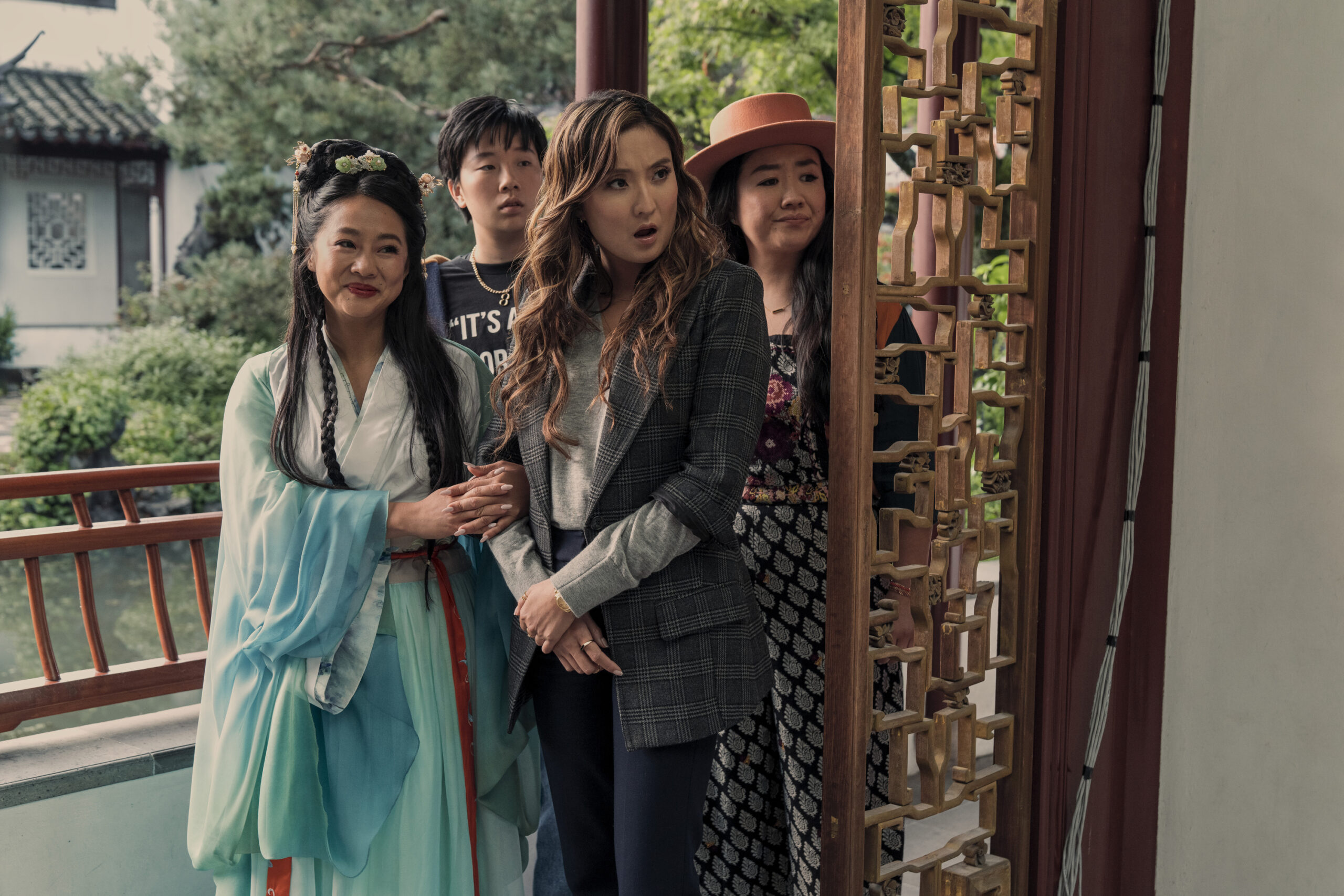
That exchange between sisters Ah Tian and Ah Girl made me laugh, partly because I understood the instruction immediately. Having studied in a Chinese school and grown up around Filipino-Chinese culture, “adult business” sounded awfully familiar to me. It usually means some variation of keep quiet, do what you’re told, and don’t complain because the adults have already decided what is best for you. Seven-year-old Ah Girl (Ong Xuan Jing) spends much of Ang Geck Geck Priscilla’s Ah Girl discovering how frustrating that arrangement can be.

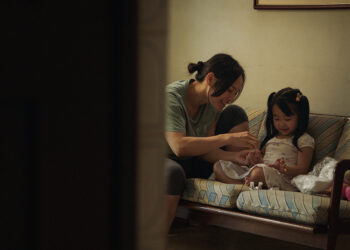
Her parents are separated. She and younger sister Ah Tian live with their father and grandmother, while weekends bring visits from their mother, who showers them with food, toys, and affection before returning them to the other household. Then Mum asks Ah Girl whether she wants to come live with her. The question sounds simple until the girl realizes that choosing one parent may mean leaving the other, and possibly leaving her sister too. Adults keep making choices around her while expecting childhood to somehow absorb the consequences.
Does Ah Girl even like those baby bangs to begin with? The joke matters because the haircut is one of many small ways the movie understands what power looks like at seven years old. Adults discuss custody, money, relationships, and where the children will live. Ah Girl worries about school, her younger sister, chewing gum, her crush, her hair. None of these things are trivial to her, and the movie never treats them that way.
That’s where Ong’s wonderful performance becomes crucial. She doesn’t play Ah Girl as the usual movie child who somehow understands the emotional subtext better than every grown-up around her. Quite the opposite. She understands pieces. She notices her father’s changing girlfriends, her grandmother’s habits, the way her mother presents herself, and conversations that abruptly stop when children enter the room. She stores these observations without always knowing what they mean, and when the meaning finally catches up, it usually hurts. At one point she blurts out, “Adults are all cheaters and liars.” By then, Ah Girl has made a convincing case for her argument.
There’s a little of Tsou Shih-Ching’s The Left-Handed Girl here, another story about girlhood observed amid domestic instability, though Ah Girl also brought me back to Beata Parkanová’s Tiny Lights, a film that literally lowers its camera to the eyeline of its young protagonist. Ang doesn’t use precisely the same technique throughout, but the experience is similar. We learn things when Ah Girl does. Adults may know the destination of a conversation before she walks into the room, but the film rarely gives us the comfort of knowing much more than she.
That limited perspective makes ordinary family decisions quietly suspenseful. Ah Girl senses that her home life is changing but can’t see the whole shape of that change. Her parents believe they are sorting out adult problems. From below, the same decisions can look like the possible disappearance of a mother, father, or sister. That’s one of the most painful things the film gets right about childhood: you may be surrounded by people and still be completely alone with information you don’t know how to process. Adults tell children not to interfere, then expect them to cope gracefully with whatever “adult business” produces.
I also liked how little the Singapore of Ah Girl resembles the city-state international movies often sell us. The story takes place in 1994, long before the Marina Bay sheen became such a convenient visual shorthand for Singapore, and Ang mostly keeps us in cramped flats, classrooms, hospitals, playgrounds, and other unremarkable places where children actually spend their time. The city isn’t presented as a dazzling metropolis. It’s home, which means fluorescent lights, cluttered rooms, tired adults, homework, family meals, and nowhere for a child to go when the grown-ups start fighting.
That domestic plainness keeps the movie from turning Ah Girl’s childhood into nostalgia. There’s pleasure here, of course. The sisters mess around. Ah Girl develops a crush. She sells chewing gum at school, a particularly cheeky pastime in 1990s Singapore (that the Chinese title, 泡泡糖女孩, literally means “bubble gum girl” isn’t lost on me). Children retain that strange ability to manufacture fun even when the household around them is falling apart. But loneliness keeps slipping into those moments, especially whenever the children realize the adults have already made yet another decision without them.
Ang is also careful not to turn the parents into monsters, which would make Ah Girl’s world much easier to understand. Mum can be needy, impulsive, and unreliable, but she clearly loves her daughters. Pa has his own failures while still trying, in whatever limited way he knows, to provide a home. Ah Ma initially seems like another adult issuing orders, yet the film gradually allows her care to emerge through actions rather than declarations. The adults aren’t evil. They’re messy, and children still have to live with the mess.
Ong carries all of this with an ease that barely resembles performing. Her face moves from defiance to confusion without announcing the transition for us. Sydney Wong is just as natural as Ah Tian, and the bond between the sisters gives the film much of its emotional weight. Whatever their parents decide, the girls understand each other in ways the adults frequently fail to. That relationship also keeps the film from becoming a catalogue of childhood misery; there’s affection, rivalry, mischief, and a toughness that belongs specifically to siblings who know they’re stuck in the same storm.
There are moments when the film’s gentleness threatens to soften some of the harsher implications of what these children are being put through. Its ending, too, prefers ambiguity to a clean emotional release. But I’m not sure a more decisive resolution would belong to Ah Girl’s experience anyway. At seven, you don’t get the explanatory epilogue. You remember fragments: a haircut you didn’t ask for, a parent promising something, your sister asking why Mum and Dad can’t simply live together. Years later, perhaps, you finally understand what everyone was talking about.
Ah Girl is a small film in the best sense. It doesn’t need to enlarge childhood pain to make it important. Ang simply stays close enough to show how enormous adults can look when you’re seven, especially when they insist that everything affecting your life is none of your business. The kids may eventually be alright.
That doesn’t mean the adults get credit for it.