As Filipiñana closes this year’s Cinemalaya Independent Film Festival, I speak with writer-director Rafael Manuel about finally bringing his first feature home. By this point, the film has already travelled through Sundance, Berlin, and other festivals around the world. It returns to the Philippines with the sort of international reception that might make its Cinemalaya screening feel ceremonial, but Manuel doesn’t describe it as a victory lap. The closer the screening gets, the less certain he sounds about what Filipino audiences will make of the film.
“Curious is one way to put it,” he tells me. “To be completely honest with you, I’m nervous.” This is the audience that matters most to him, he explains, “maybe not commercially, but emotionally and artistically. For me, this film was made for them.”
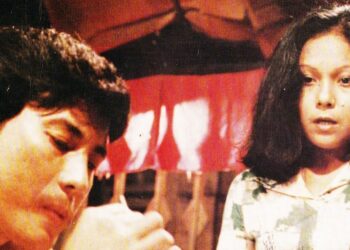
The homecoming also completes a much longer journey. Manuel first conceived Filipiñana as a feature after leaving film school, but when he couldn’t raise even a microbudget, a Filipino producer advised him to use the money he had gathered to make a proof of concept. Rather than extract scenes from the unfinished feature, Manuel wrote a separate short that could stand on its own while introducing the film’s world, including the golf course and its social order. The 24-minute film premiered at the Berlinale in 2020 and won the Silver Bear Jury Prize for Short Film.
Six years later, the feature returns to that world without merely stretching the original story to a longer running time. It widens the short’s view of the country club, placing its workers, members, and political patrons inside an institution so immaculate that its order begins to look sinister. Isabel (Jorrybell Agoto), a 17-year-old “tee girl” at the driving range, learns where she can walk, whom she can approach, and how quickly the rules change when someone powerful wants them to. Running parallel to her is Clara (Carmen Castellanos), whose Uncle Renato (Carlos Siguion-Reyna) hopes she’ll return home from New York and join the family business. Clara has enough distance to recognise the club’s inequities, but also enough privilege to imagine herself outside their consequences.
Dr. Palanca (Teroy Guzman) presides over the club, he can appear generous, attentive, and almost paternal. Manuel doesn’t announce him through the expected gestures of a villain because Palanca’s power no longer depends on open threats. The staff and members have already learned to anticipate what he wants, organising themselves around him even when he’s nowhere in sight.



Manuel tells me he isn’t interested in clean divisions between heroes and villains. The most convincing villains, he argues, believe completely in the intentions behind their actions. That conviction allows Palanca to understand his generosity as proof of goodness rather than as part of the machinery that protects him. Manuel’s most significant reference for the character is Godot in Samuel Beckett’s Waiting for Godot: an omnipresent, almost god-like figure whose physical absence never diminishes his influence.
The comparison clarifies why Palanca doesn’t need to dominate the film’s running time. His authority has already entered the club’s habits, etiquette, and architecture. People prepare for his arrival, discuss his approval, and adjust their behaviour around the possibility of his attention. Once power has taught everyone where to stand, it rarely needs to raise its voice.
A seemingly casual line during a game of golf reveals almost as much about the club as Palanca does. When Clara tries to accept a penalty, she’s told, “Everyone here plays like this.” The sentence concerns a rule being ignored, but it also describes a culture in which exemptions have become routine. Nobody needs to declare the system corrupt because everyone understands its conveniences.
I ask Manuel if he was interested in depicting impunity less as a single act of corruption than as a habit people learn to live with, and while he agrees with my reading of the line, he says he designed the film’s sparse dialogue to resist a single interpretation. An ordinary statement can stretch beyond the scene containing it, while the line also jokes about Filipiñana’s refusal to play according to familiar storytelling rules. “For me,” he says, “the form and the line and the narrative are all supposed to marry and be representative of one another.”
That relationship between form and behaviour becomes clearer through Clara. Unlike Isabel and the club’s staff, she isn’t economically trapped inside its labour hierarchy. Her objections carry fewer immediate risks, and she possesses options the workers don’t. Yet recognising injustice doesn’t mean she’ll refuse its benefits. Privilege can create room for dissent, but it can also provide more comfortable ways to postpone action.
Manuel approaches Clara as a tragic character in the classical sense. She has to begin from a place of principle for her eventual fall to register as a genuine loss. As he puts it, “when a bad person falls, it’s not a tragedy, you know? It’s a heroic outcome. So she has to start out as principled in order to fall.”
Inaction, the filmmaker says, is one of the film’s central concerns, and one he considers particularly relevant to the Philippines. He’s careful not to frame that paralysis as an individual defect, however. Filipiñana asks why action becomes so difficult when political, economic, and social power has already shaped the available choices.
“I’m not faulting anyone for this lack of action,” clarifies Manuel. “I think that the film discusses why it’s so hard to act, why inaction is so prevalent,” connecting that same difficulty to the suffocating heat and to structures that have remained in place since colonial times.

The film’s country club turns those structures into routine. Workers maintain the grounds, repeat prescribed movements, and endure the weather while members complain about the heat before retreating indoors. Clara can identify the hypocrisy because her position gives her a broader view of it, but the same privilege that enables her criticism also cushions her from its consequences. Isabel, meanwhile, is still learning the rules and why so many people have accepted them.
Seeing these routines through fresh eyes provides the film with much of its comedy. Staff rituals, political performances, and minor humiliations arrive with such precise comic timing that laughter initially seems harmless. Gradually, the same repetitions expose the cruelty underneath them. When I ask Manuel how he calibrates that tonal shift — how he doesn’t separate comedy from discomfort or explain where one is supposed to end — he starts talking about music.
Manuel and his script consultant, Franz Rodenkirchen, resisted using a traditional three- or five-act structure as their main organising principle. Such patterns remain somewhere inside the film, as they do in most narratives, but they weren’t how the pair imagined its movement. “We thought of the idea of constructing the narrative like a song,” Manuel says. “Instead of acts, we thought in verses, in choruses, in interludes.”
The description suits a film built through return and variation. Staff assemblies recur like refrains. Golf swings repeat across the driving range. Warnings, rumours, and jokes come back with altered meanings. Isabel’s fascination with Palanca doesn’t unfold through a neat chain of revelations; it gathers through glances and encounters that gradually reshape what the audience thinks it has been watching. The humour changes in the same way: a joke can remain funny while becoming harder to excuse.
For Manuel, this musical structure also offers a way to think beyond dramatic forms inherited through Western education. He connects the film’s verses, choruses, and repetitions to pre-colonial oral storytelling, where narrative travelled through voice, memory, and music. From that perspective, the form doesn’t simply carry the film’s anti-colonial ideas — its construction participates in them. In Filipiñana, Manuel isn’t delivering a critique of colonial power through a completely obedient dramatic structure. The film’s politics determine its rhythm, its repetitions, and even its apparent digressions. What may initially register as narrative looseness becomes a challenge to the assumption that every story must progress through the same imported architecture.
The images make a similar argument. The director and cinematographer Xenia Patricia arrange bodies with such exactness that the country club begins to resemble a diagram of hierarchy. Tee girls wait inside matching stations. Employees line corridors and balconies. Golfers occupy the open space while the workers who serve them are absorbed into the design. Everyone seems to understand how much of the frame they’re permitted to claim.
In considering the film’s composition as a chain of command, Manuel moves beyond blocking and into the politics of landscape. Manuel draws on historian Simon Schama’s description of landscape as not untouched nature, but as someone’s imagination projected onto rock, water, grass, and sand. A golf course is therefore a decision: about what land should become, whose pleasure it should serve, and whose work must remain unobtrusive enough to protect the illusion.

That idea shapes the film’s wide shots. The question behind them isn’t only what the club looks like, but whose idea of beauty the image preserves. The workers have a different relationship to the land than the people who own, shape, or photograph it, even though their labour makes the landscape possible. “A frame around a piece of land makes it a landscape,” Manuel explains. “And so the frame in itself is oppressive. It’s a colonial tool.”
I bring up the recurring trucks carrying replacement trees, an image that pushes that idea towards dark comedy. Trees wilt beneath the heat and are replaced before their absence can disturb the grounds’ appearance. The country club remains green because decay has been converted into a maintenance problem. Eventually, the same logic begins to attach itself to the workers, who can also be moved, dismissed, or replaced when they no longer serve the institution’s design.
The connection between landscaping and labour has been part of the project from the beginning. For Manuel, a golf course’s transformation of land can’t be separated from the workers ordered to carry it out, even when the finished landscape erases their presence. That idea has resurfaced as he works on a new film set in the Philippines in the early 1900s. While going through photographic archives from the period, Manuel repeatedly encountered rice and tobacco fields populated by “faceless, nondescript Filipino workers.” The images raised another question: who was behind the camera? Since access largely belonged to Americans and other Westerners, they also held the power to the land — and the people who worked it — would be seen and remembered.
“You really can’t speak about land without speaking about the people that toil the land,” Manuel asserts.

Agoto’s Isabel refuses to disappear into this design. Her feelings towards Palanca never settle into one readable emotion. Curiosity, admiration, fear, and something resembling an adolescent crush can coexist in the same expression, making her more complicated than an innocent girl who simply discovers that power is dangerous. Some part of Isabel is genuinely attracted to what Palanca represents, even before she can articulate why.
Manuel’s trust in Agoto pre-dates the feature. She first played Isabel in the 2020 short, which was only her second film acting job. When they returned to the character years later, many of the same collaborators came back with them. That continuity gave Agoto and Manuel a shared understanding of Isabel before production on the feature began.
Manuel remembers not immediately recognising her as Isabel during the original casting. The certainty arrived gradually as her presence grew on him. By the time they made the feature, he had come to value the depth already visible in her eyes, which led him to direct through subtraction. Rather than assign a precise emotion to each look, he withheld information and trusted that the world they had built in rehearsal would give her enough to respond to.
He rarely called “Action!” preferring to say, “Whenever you’re ready, Jorrybell.” The approach places an unusually free performance inside a film preoccupied with restriction. Isabel moves through spaces that tell her where to stand, whom to obey, and how much of herself she can reveal, but Agoto never looks as though Manuel has arranged each glance to illustrate a thesis. Once the parameters were clear, he wanted her choices to remain her own.
“If you’ve done enough work in pre-production and in rehearsals, then no matter what they do during the shoot, it’s correct,” he says. “You’ve built the world for them. You’ve built the world together, and they understand the world. The best acting comes from total freedom.”

That freedom also sits behind Manuel’s uncertainty about the film’s Filipino audience. Viewers regularly complain about the formulas of mainstream local cinema, he notes, but he remains unsure what sort of alternative they’re asking for. Do they really want different forms of storytelling, or merely the familiarity and scale of Hollywood filmmaking populated by Filipino performers?
The question carries some frustration, although Manuel also acknowledges that Filipino audiences have little access to world cinema, repertory screenings, and independent theatres. Viewers can’t develop familiarity with different forms when those films rarely reach them. What looks inaccessible may sometimes be unfamiliar only because the country’s exhibition culture has left so little room for it.
That’s why Manuel resists the idea that Filipiñana’s unusual structure makes it less local. The feature began as a project he couldn’t afford to make, survived as a short that introduced its world, and returned years later in a form shaped by song, repetition, and oral tradition. Its long journey through international festivals brings it back to the audience for whom it was originally conceived, without reshaping itself into something more conventionally exportable, or more conventionally Filipino.
As the film comes home to Cinemalaya, Manuel awaits how audiences will treat that form. Foreign, difficult, or recognisably ours?
“I’m curious to see how Filipinos will react to a narrative structure that’s actually, if you think about it, more Filipino,” he says, “and more local than maybe what it is they’re used to.”