A certain generation of Filipinos often describe the Eraserheads in superlatives: the most important band, the defining voice of an era, the country’s very own Fab Four. While not inaccurate, they tend to flatten something more lived-in, namely, the way the band’s music simply became part of everyday life.
For listeners who came of age in the 1990s, the Eraserheads marked a shift in how music sounded and felt — immediate, unmistakable. For younger listeners who didn’t grow up with them, the songs have a way of lingering. They’re passed down, replayed, and absorbed, almost by default. You don’t have to know the band’s history to recognize the music; it’s simply there, woven into the background of our culture.
Which makes the documentary Eraserheads: Combo on the Run, directed by Maria Diane Ventura, an interesting kind of challenge. Following a strong but limited run in the Philippines in 2025, the film enjoyed a warm reception at SXSW Film Festival last March and was released in North American theatres at the end of April. The task of the film is deceptively simple: introduce the Eraserheads to an international audience. The difficulty, however, lies in translating something that, for many Filipinos, has never needed introduction.
Ventura, for her part, has tailored a specific cut for North American audiences, one she believes offers the necessary context to make the story more accessible. This international version also features an overhauled sonic landscape; it is the first Filipino documentary to be mixed in Dolby Atmos, aiming for a theatrical experience as immersive as the band’s own wall of sound.
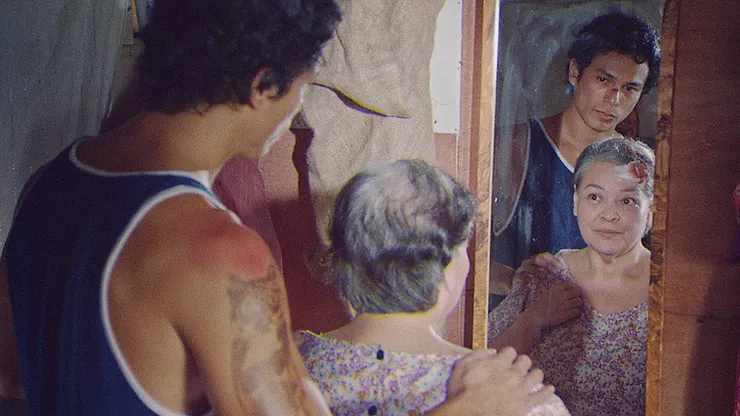
As the film continued its promotional trail in Los Angeles, I had the chance to sit down virtually with Ventura and the band’s frontman, Ely Buendia. Beyond the documentary itself, our conversation drifted toward Buendia’s turn in the historical docu-fiction film Padamlágan (“Night Light”), where I noted the quiet power of his performance as a father navigating the compartmentalized grief of a son lost in the shadow of Martial Law.


We also revisited the viral coincidence that preceded Leni Robredo’s 2022 presidential bid, a moment Buendia remains wary of claiming even as Ventura — notably, the two were once married — suggested that his support provided a necessary spark of courage (“maybe just admire, musically,” he countered with a laugh).
The conversation inevitably circles back to one of the band’s most publicly scrutinized fractures. Buendia revisits a past statement as something he now openly regrets, tracing it to a moment of self-preservation amid controversies surrounding one of his bandmates, Marcus Adoro. Rather than retelling the details, he frames his response in terms of proximity and consequence, explaining that as the band’s most recognizable member, he felt compelled to distance himself, to protect both his name and his family.
Throughout our chat, the familiar motifs of the Eraserheads story came into focus — the lingering resentments, the public regrets, and a tentative, intuitive lean toward healing. It became evident that Ventura’s film functioned as a reckoning for the band members themselves, offering a lightness in the air that had been absent for decades.
This interview has been edited for brevity and clarity.
The Asian Cut: When you watched the documentary for the first time, was there a moment that surprised you or caught you off guard?
Ely Buendia: During the interviews, of course, there were a lot of revelations. Not just from the other members of the band, but from the people who were part of our story. Most of it was actually new to me.
TAC: Diane, as a filmmaker, was there a moment during filming or editing that stayed with you?
Maria Diane Ventura: Like what Ely said, there were a lot of perspectives that we weren’t aware of. Precisely because it was a contentious breakup, there was no communication or contact for over a decade.
So it wasn’t just a surprise, it was almost like a shock to my system to find out what they had gone through during that time. I only had Ely’s perspective because we’ve stayed in touch over the years. He is family, and I’ve always known his side of the story. And all of that was also valid.
But while we were shooting and hearing the perspectives of the other guys, it was a shock to realize that their perspectives were also just as valid as Ely’s. I think my biggest takeaway was that multiple truths can co-exist. A lot of things could have been different had things been shared or communicated.
TAC: I want to talk about the craft and the structure of this documentary. It felt to me that it was like an oral history with so many voices and talking heads shaping the narrative. At what point during filmmaking did you realize that this would be the form of Combo on the Run?
MDV: Wow. [pauses] I think the fact that we shot this over three years with multiple reshoots, what everyone is going to see in the North American version is actually a different version, a bit more palatable for the audience here.
That being said, I didn’t know exactly when. We had no script. It was a spontaneous decision for me to make this film. So the story evolved as we were shooting, as we were editing. I don’t think there was a specific moment when I said, “Okay, this is it.” I think I only really understood the story toward the end, around the third year, because everything was still unfolding. Especially their relationships.
So I couldn’t shoot this in a matter of six months, because I felt like that wouldn’t really be truthful in terms of how the relationships evolved through the years, especially when they started working together again and going on tour. I felt that those all needed to progress first.
TAC: Given that you had three years’ worth of footage, hundreds of hours, what was the biggest challenge in shaping it into a cohesive story?
MDV: First of all, just rummaging through all those hundreds of hours of footage. We had around 16 hard drives, eight terabytes each. But also, because of my personal relationship with the band, I had to make sure I maintained objectivity. That meant giving each of them enough space to tell their story. Making sure it’s still about the band and not just focusing on Ely or one person. At the same time, I had to balance that with what I wanted to say as a filmmaker.
At the beginning, I wanted to honour them and make them reclaim their narrative. But as the story evolved, so did my intentions. Now, especially with the North American release, it’s also about reclaiming our narrative as a culture — reintroducing Filipino art and storytelling, and making being Filipino feel cool again for a wider audience. My answer covers a lot. Did I do that wrong?
TAC: No, your answers are perfect.
MDV: [laughs] Sorry. I’m so nervous!
EB: Did you drink coffee? [laughs]
MDV: Okay, it’s Ely’s turn na.
TAC: Ely, back in September 2021, you had that viral exchange on Twitter where a fan asked about a possible reunion. Your reply was, “Pag tumakbo si Leni” (“If Leni runs for office”). Then days later, Leni Robredo did announce her candidacy for President. Even if it started as a joke, did it feel like the band’s return took on a different meaning for people because of that timing?
EB: That’s just something that, to be honest, I don’t want to take credit for. It was really just a coincidence. Like you said, it was tongue-in-cheek. Also, I always underestimate how seriously fans take what I say, especially with regard to anything Eheads-related. So I kind of regretted posting that tweet because it coloured the reunion a bit.
I didn’t want to speak for the other guys because I didn’t know their political leanings. That was just my own personal choice. I wanted to support Leni because she’s my kababayan from Naga, Bicol, and I thought she was a good candidate. That’s it. After that, it just snowballed. I just went along for the ride. [laughs]
MDV: Can I add to that?
TAC: Yes, of course.
MDV: I know Ely always underestimates his influence. But just to add to that story, when Ely said “pag tumakbo si Leni,” she actually responded with a running emoji. That became like her unofficial declaration of candidacy. Later on, she invited him when they were celebrating basically the announcement of her candidacy. She did mention that having Ely’s support gave her courage. She also looks up to Ely. So to have him sort of support her, that meant a lot to her.
I just think Ely is careful not to make it political for the whole band. But speaking for himself, I don’t think supporting her is something he regrets. When Leni eventually lost, he also wanted to play for the people in a way that would uplift their spirits and heal them.
TAC: The documentary shows different timelines for the band. The breakup, the attempts to reunite, and then the Huling El Bimbo concert. What was it like being back on stage together in 2022 after so many years? Was it different compared to previous reunions?
EB: Getting back together to make music was always very natural for me. That’s how I met them, that’s how we became close.
The only thing that was different was the magnitude of the show. This was by far the biggest production we’ve ever been part of. It was hard to just focus on being a four-piece garage band when everything was such a big spectacle. We weren’t really used to that.
TAC: The way the film frames it, it feels like the concert wasn’t just for the audience, but for the band as well. Did it feel like a form of healing for you?
EB: Yes, of course. Subconsciously, you want things to. We didn’t go into this just to make a quick buck, which was the case before. We made sure we really wanted this, especially for the fans, and that wouldn’t have worked if there were still unresolved issues before rehearsals.
So I took it upon myself to call them one by one and settle our differences, because we wanted this to be different. We wanted it to be honest and sincere about trying to reunite. Not just a performative thing, but something real where everyone is comfortable with each other, at least on stage.
TAC: The film shows how much of the tension came from things that weren’t said. As a filmmaker, how did you approach telling a story where so much of the emotion lives in what wasn’t communicated?
MDV: That was the biggest challenge — getting a group of guys who are known to be aloof and deflective to open up. It started as a theory for me. I really believe that expressing yourself is therapeutic. In a way, they became sort of a social experiment for me. I was genuinely curious about how they see the past now, with more maturity. I think they reached a point where they could talk about it without getting too consumed by it.
I was also fortunate to have friends who helped me do the interview to get some distance. I asked Aldous Santos and Audrey Dionisio, who both know the band, to ask the tough questions that needed to be asked. Meanwhile, I was there in the room, so there was no room for them to bullshit their way around it because I also know what happened.
I’m very thankful to them for allowing that openness. It felt like the things they expressed on camera were also being told to each other. Over time, I really felt that every time they opened up, the next time they were together, there felt like a lightness in the air.
TAC: There’s a line in the film, “We were never not friends. We just had a falling out.” Was that something you always believed, or something you only came to understand later?
EB: That became important for me to say because of something I said before, that we were never friends. And like I said [in the film], I faced backlash from Eraserheads fans who took what I said seriously.
I regret saying that because I didn’t mean it. It was a moment of weakness as I was trying to separate myself from certain issues surrounding one band member, the same way that the other two guys, Raimund [Marasigan] and Buddy [Zabala], separated themselves. You might know their group, Ultra Combo, as a trio. Remember when the issue came out, they kicked Marcus out?
I did the same thing to protect my own name. It felt to me that as the most recognizable member of the band, people assume I’m okay with the controversy, as if it’s my fault, too. I had to do it for my family and my name.
But yes, I regret saying it because people took it seriously, and it still haunts me. Some fans say I betrayed them. So it was important for me to say that. We were never not friends. We just had a falling out.
TAC: After everything the documentary reveals, the success, the conflict, the distance; to borrow from one of the band’s songs, is there still a B-side to the Eraserheads’ story that feels unfinished or untold?
MDV: I tried to be as comprehensive as I could with the three years of filming. I was very lucky to have gotten all that from the band. I don’t know if there are any more B-sides because I feel like we’ve already told what needed to be told for that period. I’d like to think this is already a definitive story. I also don’t have three more years. [laughs, then turns to Ely] Do you have something more to say?
EB: As far as telling our story up to this point, I think we don’t have anything more to say. If people ask us again, we’ll probably just repeat ourselves. But after the movie and the reunion, it feels like a new chapter has opened. We’ll just see what happens next.