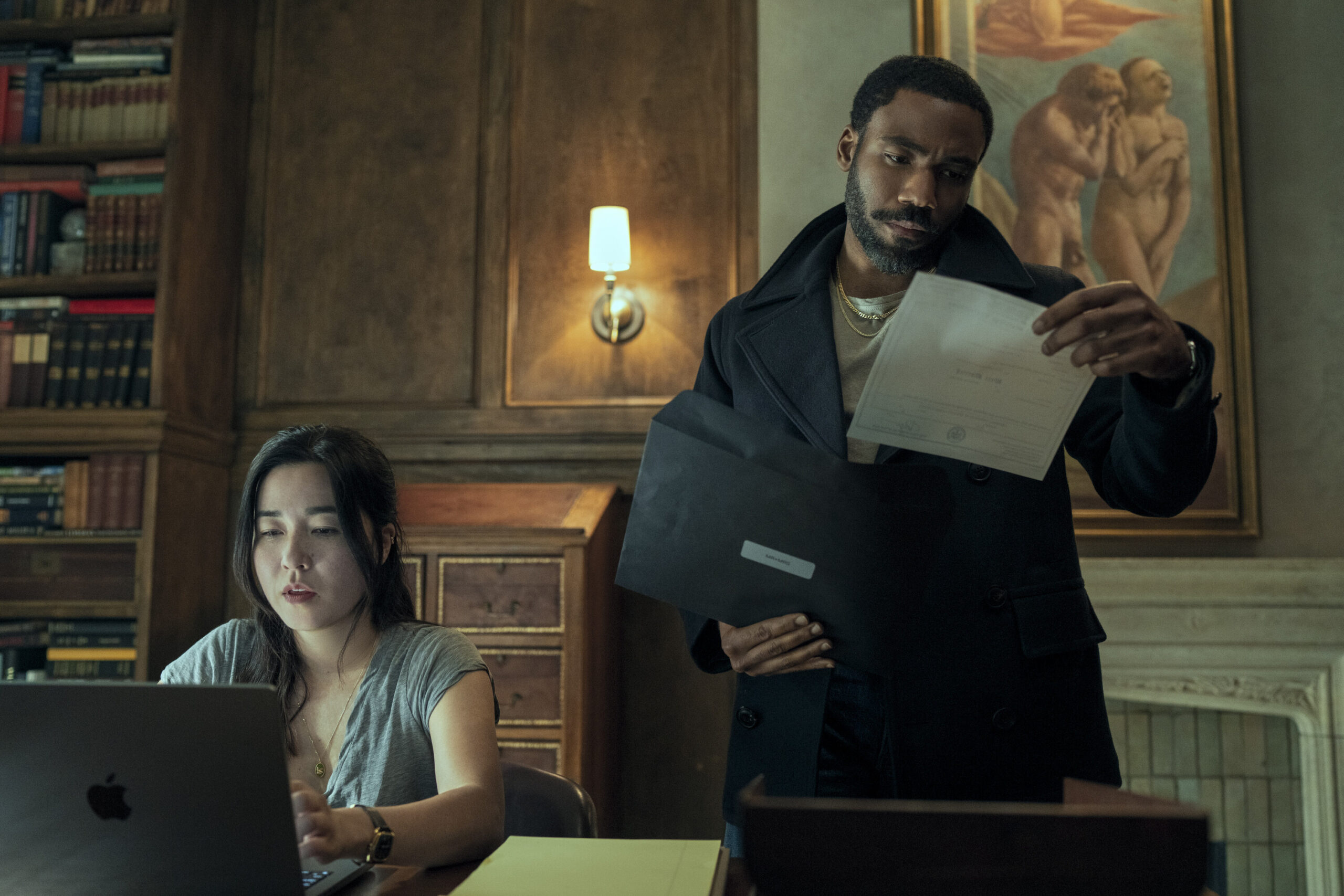
Celine Song’s Materialists is many things, but a disbeliever in the inevitability of love is not one of them. Time and again in the film, Dakota Johnson’s Lucy tells the people around her that even if they don’t believe they will find their happily ever after, she believes it for them. Sure, she’s telling her clients what they want to hear, but she does it with such earnest conviction it warms their, and our, souls. When it comes to herself, though, she seems to have lost faith, and Song will have none of it.
Materialists is a bright-eyed though sober-headed romantic, which is one of its greatest little miracles. Set in the grim landscape of modern dating — congested as it is by apps desperately trying to get us to pay for ever more clever ways to swipe ourselves into love, and howling with the cries of lonely yearners — Song presents us with a vision of organic hope. Lucy, a matchmaker in New York City, works to help people achieve their dreams by pairing them up with suitors who check all their romantic boxes. Working in the business of love for others, she eventually finds herself making the difficult decisions her clients are constantly making: should she get with rich, perfect man Harry (Pedro Pascal) or with working-class ex, John (Chris Evans). More and more Lucy comes to believe for herself what she believes for others, that true love is possible.
Song’s sophomore feature isn’t as saccharine as your typical romantic comedy. In fact, at times it becomes down-right depressing for its unflinching depiction of the power imbalances and superficial judgements inherent to modern-day dating, not to mention its skewering of the words (capitalistic and cold) we use to talk about love. Love is a “deal,” marriage is a contract we sign, finding a partner is filled with “risk” and “reward.” This film is realistic as it paints a portrait of a striving toward happiness in our busy and cynical and often dangerous world. But despite all of the brutal muck that surrounds us, Materialists, like Lucy, maintains the hope that we will find our happiness, even if we ourselves don’t believe in it anymore.
We sat down with Celine Song on the Toronto leg of her promotional tour for Materialists to learn more about why a hopeful philosophy when it comes to love is needed now more than ever.
The following interview contains spoilers for Materialists.



TAC: Why did you feel the need to tell this story right now?
Celine Song: Well, I think that it was something that I found quite troubling about the time that I worked as a matchmaker for about six months. When I was working there, something that really troubled me is the way that this thing — dating — that so many of us have to do in pursuit of love, it’s wild because the language that we have for dating seems too far away and too different than what we know about love. And Love is a miracle. Love is right. Love is this ancient feeling, this ancient mystery that makes life worth living makes fools of all of us. And this thing, if you think about it, it’s wild to me that though the game we’re playing in order to have love in our lives, it seemed that language around it was too much about the numbers, the height, weight, income, age.
We were kind of reducing each other into a set of statistics or some kind of a way that we’re objectifying and commodifying each other. And then a result of objectifying and commodifying each other is that we’re going to, of course, objectify and commodify ourselves. And then all the judgment and hatred you have for each other, you’re going to start to have for yourself, and the natural end of that is always going to be dehumanization.
TAC: One of my favorite lines is when Lucy is talking about her parents growing up. She says that watching her parents fight, she began to resent her parents, but then her parents began to resent her as the kid, too, because she was witnessing this terrible aspect of them. It blew my mind because I’ve never heard anybody articulate that so succinctly, how we turn on each other and ultimately it is a turning on ourselves. That was so beautiful and powerful. Thank you for that. I also wanted to ask you about your influences. So who were you watching? What were you listening to as you were writing the film?
Song: Well, I feel like there’s a very long and beautiful lineage of films like this. Anything from Billy Wilder to James L. Brooks, and then of course, more recently, Nora Ephron, right? So there are these movies that have been not just about love and romance and dating, but they’re always going to be about something more. They’re always going to be something about what it’s like to be a modern person trying to love and trying to live. Romance is such an amazing genre because we get to basically say, “Hey, we welcome the audience to walk into a movie theater and we’re going to spend two hours just thinking about and feeling love.” That’s it. We’re going to talk about love. We’re going to feel love. We’re going to think about nothing but love and what an amazing invitation and what a joyous invitation. But then the thing that I really admire about Nora Ephron or Jim Brooks, or even Billy Wilder, is that they will always take that opportunity to talk about something, to talk about etiologies and philosophies and the things that actually fuck us up, the things that really make us feel, it’s always a question of what kind of people are we? Which is always going to be a thing that they’re going to address while we have an invited audience of people who’re here to feel love.
TAC: I really wanted to talk about Zoë Winters’ character Sophie. Thank you so much for including that story. How did that come about? Why did you decide to bring in the idea of a very common experience of assault, of date rape?
Song: Well, I feel like it was always in the DNA of the film. Do you know that song “Satellite of Love”? It’s this Lou Reed song, and part of the lyrics go, “Monday, Tuesday, Wednesday, Thursday, Harry, Mark and John.” And the thing about the song is it’s about this woman who is dating and it’s like the three men [she dates through] Monday, Tuesday, Wednesday. The [film’s] characters’ names are after Harry, Mark and John. I read some statistic that one in three women in their lives suffer sexual assault. And what that means is that of the Harry, Mark and John — two of those characters are going to be Harry and John, but then Mark is of course the name of the man who assaults Sophie. So to me, it was always, even in the phase of naming my characters, I think that it was already in the DNA of it. And it’s because, if I intended to show up with this movie and said, “I want it to be real about dating, no, I really, really want to be very real about dating and be as honest as I can and to tell the truth the way I believe it,” then it just felt irresponsible to exclude a very natural and omnipresent sort of like a possibility that has been part of dating for as long as there was dating. And so to me it felt like I didn’t have a choice in a great way. The only reason why I wouldn’t have done it [included Sophie’s story] is if I felt like I didn’t feel like it was worthy of handling it or try to handle it. So it was very much like, no, I have to, if I intend to talk about dating in a direct way.
TAC: I feel so grateful that you do talk about it because you can tell with the character, she does feel a bit of shame about it and she shouldn’t because it’s not her fault that this happened to her, but you talk about it. And so it’s almost, I don’t know, it kind of opens up the possibility for dialogue amongst the people who are watching it. So thank you for doing that. I wanted to also talk about New York City. You make it seem so dreamy and beautiful. It’s almost a character. It’s like this very hazy, beautiful character. What were your intentions in capturing New York City, did you want it to be a character?
Song: Yeah, of course. Well, I feel like it’s a city that I really love. I’ve lived there for 14 years since moving away from Toronto. And I think that there’s a difference between liking a thing and loving a thing, and loving a thing means that you are also going to accept the parts of the city that are darker and have some flaws. You know what I mean? That’s what love is, right? Liking something anybody can do. But so I always am interested in depicting New York City and the way that people who live there might experience it, which I think would be true of any of my hometowns, including Toronto, where I’d be like, if you asked me what’s my Toronto, it would always be some street that I walk by just outside of my house a hundred times. And that’s actually the most romantic place that you could imagine. So I think that’s the kind of way that I wanted to look at the way New York City is shot. We don’t have a drone shot, you know what I mean? It’s not about the way that New York is always seen, it’s always about the way New York is seen that you can walk to.
TAC: And it does, it feels warm and like home. I love that. I also wanted to ask, when it comes to the cast, did you have Dakota Johnson in mind when you were writing Lucy? How did the people in the film come to it?
Song: I don’t write the characters with actors in mind. And the truth is I just write the characters and then I sort of go out like a matchmaker in search of the character’s soulmate. So I’m always looking for, well, there’s Lucy, and who’s going to be the soulmate of Lucy? And then you go out. And what I got to do as part of releasing Past Lives is that I got to meet a lot of actors and I had really wonderful meetings with really talented actors, but Dakota is the one that I sat across from. And then the whole time I was talking to her, I was like, I think she might be Lucy. And before I got up from lunch, she had already left and I was sitting there, I texted A24 and my producer, saying, I think I found my Lucy. So again, it’s a pretty inspiration-based process to cast. It always has to make me feel so inspired to imagine her as Lucy or Chris as John or Pedro as Harry.
TAC: What do you want people to take away from the film?
Song: Oh, well, I feel like this film is as romantic as I could muster, given my own cynicism and my own practicality and my own materialism. And I think that I was trying to be as honest as I can about the limit of how romantic I feel about it. And I think that to me, so it’s not really a matter of, well, this is what it is. It’s so much more about, well, what does this actually reflect for you? So much of it, I think of it as more of a way for us to start a conversation. I feel like I want to ask, what did it inspire in you? Or what did you think about when you were watching this movie about the way you love, and the way that you date? To me, it’s really a question that starts a conversation more than me saying like, well, this is what it is. I mean, this is what it is for me as a person who made it. So now the rest of it is about the audience that is going to show up. And my dream for the movie is that if you show up with whoever that you watch the movie with, you want on the way out of the movie theatre for the conversation to be beautiful and vibrant and deep. And I want this conversation to be about getting to know each other deeper.