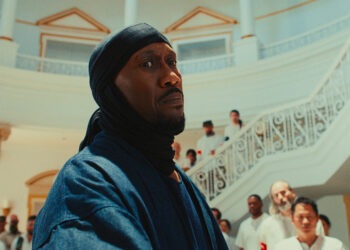
When actor Duy Nguyễn first spoke with filmmaker Ashley Da-Lê Duong about playing her father in Ba’s Book, he had one concern: he didn’t particularly look like the man he was supposed to portray. Duong assured him that it didn’t matter. As Nguyễn explained during our recent conversation, his job wasn’t necessarily to deliver a convincing impersonation of Anh Duong, especially with the man’s actual family watching. “In a way, the worse I do at being him, the better for the film,” he told me. It’s a rather unusual way for an actor to describe his performance, but having seen the film, I knew exactly what he meant.
I caught Ba’s Book during its run at this year’s Toronto International Film Festival, and I was particularly taken by how Duong turned the process of reconstructing her father’s memories into a family affair. Drawing from a memoir Anh had written about his childhood in wartime Vietnam, his experiences during the Iranian Revolution, and his eventual migration to Canada, the documentary brings father and daughter back to Vietnam, where relatives participate in reenactments of events they themselves experienced.
Nguyễn plays a younger Anh, while the real Anh and his siblings watch, occasionally stepping in to correct a gesture, dispute a particular recollection, or insist that something happened differently. Some of these exchanges are genuinely moving, while others are surprisingly funny. I especially enjoyed how easily the family could go from discussing painful memories to arguing over the smallest details of a scene. It’s through these interactions that we begin to see the people beyond the history they’ve lived through.
Ahead of the film’s opening-night presentation at the 30th Toronto Reel Asian International Film Festival on November 11, I had the pleasure of speaking with Duong and Nguyễn about the experience of making Ba’s Book. What began with a playful question about who was the bigger perfectionist on set (spoiler: it wasn’t Ashley) developed into an insightful conversation about filmmaking, family, and the complicated business of recreating somebody else’s past. Duong spoke about discovering how much she had in common with her father, someone she’d grown up believing was completely different from her. Nguyễn, meanwhile, shared something I hadn’t anticipated: how playing Anh made him confront his own experience of leaving Vietnam and building a life in Canada, including the years he had spent away from his family.
We also talked about the film’s unexpected humour, the challenge of balancing a director’s artistic ambitions with her responsibilities as a daughter, and what happens when the people whose lives you’re recreating start offering their own directing notes. In fact, Duong mentioned that this was the first time she and Nguyễn had been interviewed together, and she found herself remembering things about the production through his answers. It was a lovely little moment in a conversation about a film so concerned with how people remember and, sometimes, remember differently.


The following interview has been edited for length and clarity.
The Asian Cut: Ashley, your father wrote the memoir from his perspective, but once you brought the family into the filmmaking process, other versions of those memories began to emerge. Was there a moment when you realized that you weren’t simply adapting his book anymore, but making something that now belonged to the entire family?
Ashley Da-Lê Duong: I think that was the objective from the beginning. My purpose wasn’t to make an adaptation of my dad’s book. He already wrote his book, and I wanted him to be able to tell his story his way. It was more to be used as a way of connecting our family together, connecting with my relatives, connecting with my father.
One of the things is that they can’t read his book because they don’t read English, and they actually hadn’t really ever talked about any of these things. So I found that film was a medium for that. It was kind of built into the purpose of the film.
TAC: Duy, you’re playing a real person who isn’t just alive, but actively involved in the production. Talk to me about your process and approach to playing a younger Anh. What did you learn from spending time with him that you couldn’t have learned simply by reading the script or his memoir?
Duy Nguyễn: When I first met with Ashley, we had a Zoom call before she officially cast me, and I told her, “I don’t really look much like your dad.” And she told me that that doesn’t matter. That’s the truth of it. It doesn’t matter. My job was not to play him — to be him — because in front of his family I would never be him. Instead, it’s the fact that we are attempting to tell his story, and any inaccuracy is an invitation for the family and for him to go in and have a conversation.
So in a way, the worse I do at being him, the better for the film. That takes a lot of pressure off from the start. At the beginning, I just thought, “I’m here to help Ashley tell the story, to help tell her dad’s story and reconnect him with his family.” But I did not realize how similar his story is to mine, even though we’re from completely different generations. He moved away from home to chase ambition, to be someone, and I did the same. I left behind my whole family in Vietnam, and I never thought about the life of my family in Vietnam that I might have missed, all these years being abroad.
Telling this story of him meeting his family for the first time in a long time reminds me of myself in such a profound way. I never thought of my family’s struggles in Vietnam without me in all the years that I’ve missed, and this movie made me confront that part of myself that I’ve been ignoring. It’s very unexpected.
TAC: There’s a fascinating moment in the movie when Anh sits alongside you as you revisit his time in Iran, including how he learned to draw. What was it like sharing the scene with the man whose younger self you were portraying?
DN: Are you talking about the learning-to-draw scene?
TAC: Yes, I am.
DN: [pauses] There’s a lot of nerves, even though I said my job is not to be him perfectly. But he’s right next to me, and I know how detailed he is. I know that after each scene, he’s going to give me a bunch of notes. But the fascinating part is, it didn’t happen. We did that scene, I think, in one take, and then the family started talking. That’s all that mattered. It’s just the start of conversations. The reenactment is for the family to have a glimpse of his life. So, lots of nervousness, but at the end of the day it’s just to start conversations.
TAC: One thing that really interested me was how often the discussions around a reenactment became more revealing than the reenactment itself. Ashley, in some scenes, someone corrects a gesture or a small detail, and suddenly you learn something about their relationship to the past. In the editing room, how did you decide when to stay with the performed scene and when to pull back and show the family negotiating the reenactment?
AD: In the editing room, for instance, there’s that one scene where we’re running into the bomb shelter. I didn’t intend to film a lot of the discussion with my dad beforehand. I was trying to film it so that it was one scene, and he wanted me to film it so that it was two scenes. I remember that was one moment when I started getting frustrated at my father. Afterwards I realized, in his roundabout way, it was really important that it was two scenes because people had died there, and it was a very singular thing.
When we were editing, we were trying to make sure that almost every scene had a bit of both the fiction and the documentary. Originally we were trying to make it so that it was very distinct: there was the fiction part and then there was the documentary part. But we ended up making it a more fluid thing because, to me, it was about these different memories of the past and the present being in the same locations, layered on top of each other.
It was a bit of trial and error. There were moments where I thought a scene would have more of a fiction feeling and it ended up being more of a documentary scene. It just depended on the material we had and what felt stronger.

TAC: Because the relatives sometimes remember events differently, I imagine there were moments when you had more than one interpretation of Anh to work with. As an actor, how do you navigate that balance?
AD: [to Duy] I remember one instance, by the way, for you to talk about. One instance, which we didn’t include in the film, was before my dad started speaking to me, a lot of the relatives were telling me how he kind of didn’t have to do chores, he got to study, and they were left to their own devices sometimes. He was always focused on studying.
So, hoping they would have a different opinion of him, we created a scene about him protecting all of his siblings from bullies. But then when we showed it to them, they were like, “Yeah, it was just like that,” and they kind of went against what they’d told me before.
Then I realized, “He’s here, he’s the eldest, he’s respected, and maybe he’s both.” Maybe he did protect them against bullies. But also, when I was thinking about it, I was hearing such different versions of my dad. Is he that protector boy, or was he just fully focused on his studies? They seemed to be agreeing with both versions.
DN: There’s surprisingly not a lot of contradiction between the family’s memories of him and his memory. It’s more like different pieces of a puzzle, different sides of him that he decided to show in front of his family and the side that he thinks about himself. Together, it paints the man that we have in the film.
TAC: Ashley, you’re wearing several hats here — director, daughter, and someone asking relatives to revisit things they might have spent decades trying not to talk about. How did you navigate those moments when what was best for the film might not necessarily have been what was best for the person in front of the camera?
AD: That was the central challenging thing about this film for me. Being the daughter, I’m also feeling protective of my father and my relatives, and I don’t want them to have difficult or uncomfortable experiences.
But at the same time, my dad wanted to make this film. He didn’t necessarily want to come to Vietnam, but he wanted me to make a film, and he was very supportive of that. My aunts and uncles were, too. I felt that if I was going to ask everybody for their time and energy, it was also part of my duty to make something meaningful and good, if I was going to ask for their help that way.
At the end of the day, it was about learning why my dad might not want to talk about certain things. That was part of my journey with the film. It was also about being transparent with my dad and telling him, “I’m doing this because of this. Do you want to do that? Or do you feel like we should talk about that?” Just trying to be as transparent with my dad and my relatives as possible about the process.
DN: [to Ashley] I can add to that. I remember this being one of the first conversations we had before going on set. I remember asking you, “This is a very personal story, and you’re asking your family to revisit parts that might not be comfortable for them. But we’re also making a film, and the film needs drama. Are we going to push? How hard are we going to push for certain matters?”
I remember you saying — and this gave me so much respect for the whole project and for you — that it doesn’t matter if the movie is good or bad. Your family always comes first, and we never want to push anything. We’re going to present to them the reenactment, and if anything comes out of it, it comes out. And surprisingly, so much came out of just that. You approached it with respect, and the result was amazing.
AD: This is our first time doing an interview together, and it’s so nice to have you on the talk because you remind me of things that I don’t remember sometimes. [laughs] It’s great that somebody who was also on this journey with me is talking with me.
TAC: One of my observations is that for a film dealing with war, exile, and generational trauma, Ba’s Book can be surprisingly funny. I particularly enjoyed the family dynamics as they go from discussing something painful to arguing over a tiny detail of a scene. How much of that humour did you anticipate, and did those family dynamics affect the atmosphere on set?
AD: A lot of the humour we actually did experience live during the shoot, but we found a lot of it when watching it in editing. Sometimes when I was filming, I was so focused on things — I was adding to the humour sometimes because I would get frustrated and want things to go a certain way, and they weren’t. But then you have the perspective to look back on it and go, “Oh, yeah.” I didn’t expect all my family to fit so naturally into being directors. Some of those moments were happy surprises that I picked up more strongly on in editing than when I was actually there filming.
DN: [to Ashley] When you’re on set, you’re very focused on what you’re doing and telling the story. Also, the Huế accent is almost impossible to understand if you don’t know the language. But your family is so funny, even when they’re doing nothing. I remember laughing and trying to hold onto my laughter in between scenes because I didn’t want my laugh to make it into the film.
There’s something about the Vietnamese diaspora family: it has a very different dynamic from a Vietnamese family living in Vietnam. This is the first film I’ve ever seen from a Vietnamese diaspora director that features family dynamics from both worlds. Your relationship with your dad — that disconnection — is, unfortunately, a very common story among the Vietnamese diaspora.
But then the relationships between family members in Vietnam are so different, and a lot of Vietnamese people can relate to them. I die laughing watching the film all the time because I can pick up little nuances that remind me of my own family in Vietnam. I’ve never seen a film that I can relate to on so many different levels. Your family’s hilarious. [laughs]
AD: I think that’s one of the biggest gifts of doing this whole process. At the beginning, [Uncle] Chương would make a joke or do something, and I wouldn’t necessarily understand his sense of humour. By the end, I felt like I understood them so much better. That’s how you know you’re closer to someone: when you understand them and understand their sense of humour better.
TAC: The movie ends up being about how an entire family communicates with one another. Ashley, what have you learned about your father that you don’t think you could have learned from reading his book alone?
AD: I used to think my dad and I were like different animals, basically — totally different kinds of people, that we had almost nothing in common. He’s an engineer; I’m an artist. Growing up, he barely said anything. Before he wrote his book, he never even mentioned to me that he lived in Iran, not once. I found out about that through the process of him writing his book.
What I learned making this film was that I was seeing a lot of his distancing maneuvers and some of his stubbornness, and I recognized that in myself. I recognized how similar we were in very fundamental ways. We’re a lot more similar than I would have expected.
I also learned, making this film, that I started to notice how lonely he was in so many stages of his journey because he was often leaving home and going places by himself: first to Saigon, then to Iran, then to Canada. Growing up, he held onto our family very closely. I could see that he had already had to say goodbye to his family once, the ones in Vietnam. Maybe that’s partly why he always wanted me to be home more. He held us very close in his heart, and I wondered if that was related. That was a thought that came to me while we were filming.
TAC: How about for you, Duy? After spending so much time inhabiting this man’s earlier life, what has stayed with you about him?
DN: God, so much. I think about my experience and his story constantly. It has never left my brain since we wrapped on the film.
As an actor playing somebody, my process is to dissect this person, divide them into different pieces, find their flaws, and this and that. Going into it, I was like, “Okay, there’s a problem, and I’m here to fix it.” I did not expect that I wasn’t there to fix any problem. I wasn’t there to help this man. I was there to help myself, because so much of my journey in life mirrors his.
His resistance to going back home, his disconnection between him and his family — these were what I experienced moving away from home for school and then staying here by myself. Every day, being alone in Canada, it reminds me of what he went through. It reminds me of how he overcame that through the film, how he got to see his family’s struggles through the film — how his sister felt about him having an education and she hadn’t, and how he defended himself by saying, “My life is not as easy as you think, either.”
It hit me. I did the same thing. I do the same thing. I try not to think about my family because it’s a defense mechanism. If I think about the life that I missed with my family back home, it would break me. I would never be able to chase my ambition. That’s what happened [to] him.
But at the end, he got to find that part of himself with his family, and they got to have that reconnection. It reminds me that I have to do the same. I have to take that first step. I won’t have another person telling my story. Maybe one day my daughter will tell my story, but I have to do the work myself. He helped me as much as I helped tell his story.