It’s no secret that cinema functions as much as a tool of documentation, protest, and even revolution as it does a form of art and entertainment. Entire movements and periods — cultural, artistic, and otherwise — have taken place precisely because of the inherent political nature of the moving image. New Queer Cinema in the early-1990s, for instance, breathed life into independent LGBTQ+ filmmaking efforts that were systematically denied to queer artists for decades, ultimately paving the way for mainstream success in the late-2010s).
In the same vein, within the last decade, calls for equitable representation in English-language films (in front of and behind the camera) have inspired stories rooted in cultural specificity, racial diversity, and the representation of the traditionally underrepresented. For better or worse, one’s identity has become a primary driving force behind a lot of the stories we now tell, the intention with which we tell them, and, of course, the conversations they ignite after the fact.
On one hand, this larger push for equity in the film industry has allowed new milestones to be crossed and, by extension, new stories and voices to be told and heard. Shang-Chi and the Legend of the Ten Rings introduced the first Asian-led superhero movie in the biggest franchise in the world; Michelle Yeoh became the first Asian performer to win the Oscar for Best Actress; Domee Shi became the first woman to receive sole directing credit for a Pixar film — these are just some notable examples of progress.


That said, there have been films wherein the incorporation of representation for the sake of it has yielded half-baked stories that, despite the best of intentions, feel more concerned with the buzz of sociopolitical discourse than actually engaging in or illustrating the systems of power at play. Powai unfortunately falls into this category.
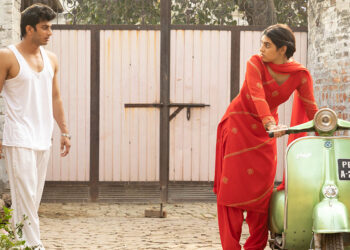
Billed as a triptych, Powai intertwines three different stories led by women of varying socioeconomic status living in the eponymous Powai (an affluent suburb in Mumbai, India), each of whom suffer, in different ways, under the larger patriarchal umbrella of Indian society. In the first story, Smriti Mishra plays Usha, a widowed domestic worker who is in the process of moving into one of the neighbourhood’s new high-rise developments with her deceased husband’s family and her daughter. The second story follows Shruti Pandey’s Rubina, a divorced preschool teacher who dreams of becoming a beautician and living a different life altogether. Lastly, Atashi (Urmila Mahanta) leads the third story as the sole woman employee of an up-and-coming tech start-up.
It’s almost inevitable to see parallels between Powai and Alejandro González Iñárritu’s Death Trilogy (Amores Perros, 21 Grams, and Babel). Like Iñárritu’s gritty dramas, Powai’s synopsis alone promises a deep dive into an evolving neighbourhood within which wealth gaps are wider and more apparent than ever and women still struggle across class, ethnicity, and age. However, what Kuldip Patel’s film essentially lacks is a degree of humanity that would make Usha, Rubina, and Atashi feel more like unique characters who stand on their own and less like pawns in film with what feels like political motive. Indeed, there’s a willingness to highlight the patriarchal system that plagues the three women in various ways — this is great and admirable — but in the way they are written, Patel’s women don’t seem to have an identity beyond their plight or victimhood.
This isn’t, of course, to say that the film is bad. In fact, it’s a well-crafted film. Patel resists pomp, opting instead for an observatory, almost documentarian approach, often shooting his characters from afar. Here, Vidya Nath Bharti’s cinematographic work is notable: Usha, Rubina, and Atashi are often shown boxed in by the physical structures around them — doorframes, hallways, windows, and the like — which emphasize how trapped they all are in their respective circumstances.
It also helps that Mishra, Pandey, and Mahanta are all excellent performers, doing what they can with the somewhat one-dimensional characters and finding nuggets of personality to give to us. Mahanta, specifically, is a standout precisely because — without spoiling anything — she has her moment of triumph (even if it is rather minute in the grander picture).
Patel, too, must be commended for his demonstration of keen instincts where tone and voice are concerned, especially when you consider that Powai is his debut feature (and his second-ever project), coming a decade after his debut short. A Powai citizen himself, it’s clear he’s familiar with the neighbourhood and the people that populate it; you can feel how personal the film is.
It is, therefore, a shame that Powai falters in its overall follow-through. It sets up an intimate viewing experience from a perspective that has historically been silenced, but it leaves a lot to be desired, particularly where the women’s individuality is concerned. We see Usha, Rubina, and Atashi struggling to play the hands they’ve been dealt and resisting (as much as they’re able to) the unjust statuses they’re born into, but that’s ultimately it: we only see; we don’t get to know. The camera continues to roll. The system lives on.