At first glance, Park Chan-wook’s Thirst is irregularly paced, like a ragged sigh. Beginning with a sparse and contemplative meander, the film takes its time getting to the point. And when it does, it erupts, racing to its denouement with an exuberant flourish at a stark contrast from the film’s opening moments. But take a closer look and you’ll find something alive in this film, something contagious.
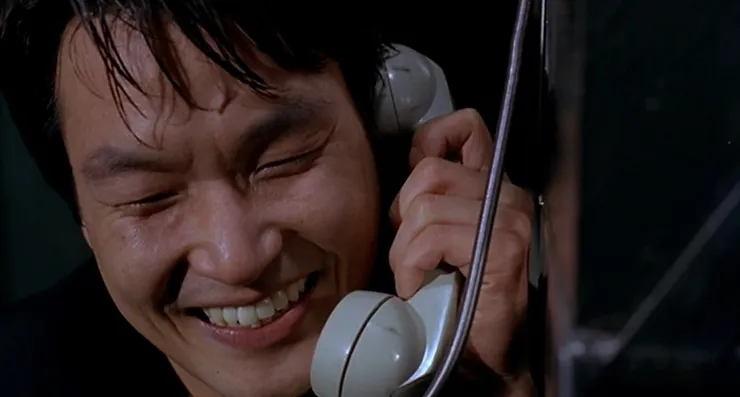
The film begins on a bare, white wall around a bare, white door — asceticism incarnate — its only adornment the trembling shadow of a tree thrown upon it by the sun setting outside the window. The door opens and Sang-hyun (Song Kang-ho), a Catholic priest, enters. He’s visiting a patient. Sang-hyun volunteers at a hospital to provide religious counsel to patients — he takes confession, reads last rites, and offers a listening ear to anyone who should need it. But despite his diligent service, he finds doubt and a feeling of powerlessness bubbling up inside of him; surrounded by death and disease, his faith falters and he desires to feel more useful. And so he decides to volunteer as a test subject for a vaccine that doctors hope will cure the Emmanuel Virus (EV), a deadly and horrifying disease. Sang-hyun, who hopes to make a useful contribution to humanity with the donation of his body to science, is infected with EV in the process, but after a blood transfusion, he makes a full recovery.
When he returns from the experiment, Sang-hyun finds that he has grown a following of people who believe he is a saint who can heal others. Among his disciples is Mrs. Ra (Kim Hae-sook), the mother of Kang-woo (Shin Ha-kyun), who is sick and is also a childhood friend of Sang-hyun’s. Mrs. Ra convinces Sang-hyun to “heal” Kang-woo, which he does, at least, he tries to by reading prayers over him. As thanks, Kang-woo invites Sang-hyun over to a weekly mahjong night at his and his mother’s home. There, Sang-hyun meets Tae-ju (Kim Ok-bin), Kang-woo’s wife. The priest and the young woman find themselves attracted to each other, clumsily and breathlessly grasping at each other when they get the chance. With a soul already beleaguered by guilt at his feelings for Tae-ju, Sang-hyun is further horrified at the discovery that his blood transfusion has turned him into a vampire, and as he and Tae-ju drift closer together, with Tae-ju claiming that Kang-woo beats her, Sang-hyun finds himself moving further and further from religion and closer to monstrosity.

The film is based loosely on Thérèse Raquin, a novel by Émile Zola about a woman who has an affair, and, with her lover, kills her husband, who, once dead, haunts the couple through sinister visions, keeping them from ever reaping the fruits of their crime. Here, the story of Thérèse Raquin is braided with a tale of vampirism, with Tae-ju not only persuading Sang-hyun to kill her husband, but also to turn her into a vampire.
It’s an intensely entwined and busy plot, which Park wrote alongside Jeong Seo-kyeong. The first half of the film moves slowly, laying groundwork to support the mayhem of the latter half. The involved plot and the film’s pace lead to an interesting effect: the experience of watching Thirst is aggravating and unsettling. But this is part and parcel of the point — Park seems to want us to feel unsettled. First we’re lulled into a state of calm by the film’s clean and poetic exploration of a man’s attempt to find meaning in himself, to reiterate his faith, and then we’re jolted by the electric appearance not only of Tae-ju but also of vampirism and illness, of mess and disorder. Thirst moves upon us like a virus, like vampirism, infecting slowly at first and then all at once.
The Emmanuel Virus is described as a repugnant thing — it appears on the skin at first as pustules, which slowly travel inwards and toward the organs, at which point the virus begins to consume one’s insides, and so one begins vomiting up blood. With a similar cadence, the film begins with a slowness that can’t but be deliberate. As we learn about Sang-huyn’s conflicted mind — his lagging fath and his almost aching desire to feel more useful in the face of the finality of death and destruction — and as we watch him embark on a journey that is captured by Park in a beautiful vignette of almost lyrical asceticism, we get the feeling that even if Sang-hyun doesn’t survive the vaccine trial, he will find the proof of goodness, or divinity, that he so desires. Park primes us to expect the story of a man becoming a saint, but what we get is a near hagiographic parody.
Just as the step of the virus is, if not invisible, then something rote, something to be expected, so too does the first act of the film move with a measured sort of sobriety, no doubt helped along by the film’s visual palate, wheaten and sparse and hazy, dulled greens and blues and yellows. As Sang-hyun takes steps to find spiritual healing, we watch with a certain calmness. But then shit hits the fan and blood begins to explode out of him. As he slowly but surely realizes he has become a vampire, the film becomes more vivid, as if Sang-hyun’s surroundings are lapping up his blood and becoming more saturated in the process, more full. As he enters Tae-ju’s world more and more, as he is entrapped by the delicious femme, the film seems to almost soak up her earthliness until it finally becomes ripe, and then it explodes with a bloody crescendo in its final act, just as blood explodes from an EV patient.
To watch Thirst is to be pulled back into the body, is to be infected by it. It certainly is a story about the ruination of a religious man, but more than that it feels like a study in full immersion. Similar to the sensory awareness contained within Stoker, Thirst offers a sensory world that consumes us. Sang-hyun’s sounds, the textures he touches (at one point he sniffs Tae-ju’s feet with such hungry ferocity we can feel his breath on our skin), the blood he tastes, all seem to go through our senses, too, until we feel his uneasiness at Tae-ju, the monster he hasn’t so much created as unleashed.
There is a lot going on in this film, but prime among all its marvellous jewels is its contagious cadence. In turn beautiful and repugnant, saintly and devilish, Thirst is a feast, a ball, an extravaganza of bodies, blood, and life; but it takes its time in getting to it, in the way that we take our time in getting sick. With Thirst, Park has managed to give disease its own special meter and step; what a stunning achievement this film is.