There’s something quietly elusive about Two Seasons, Two Strangers. Conversations are hesitant, its characters often seem unsure of what they mean to say, as though something is always just out of reach. Yet it’s in that uncertainty that the film finds its meaning.
Directed by Shô Miyake, his follow up to 2024’s All the Long Nights, and adapted from the work of cartoonist Yoshiharu Tsuge, the film unfolds around two encounters: a chance meeting by the sea in summer, and a winter journey that brings a struggling screenwriter to a remote inn. Two Seasons, Two Strangers is less concerned with structure than with embracing moments. Each frame seems to hold something just beyond what can be put into words, in the space where language falls away.
And for its characters, that space offers relief. When speaking feels suffocating, they begin to find that connection doesn’t always come from it. Nagisa (Yuumi Kawai) carries herself with a cool, effortless elegance, while Natsuo (Mansaku Takada) is marked by an awkward sincerity. Their conversations falter in the same ways, with pauses and half-formed thoughts, but their actions move with surprising clarity.


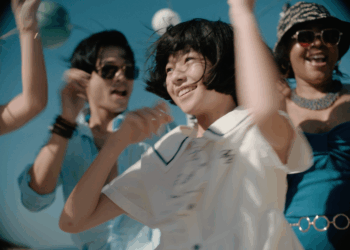
There’s an ease, even a sudden impulsiveness, in the way they come together. They talk about nothing and everything all at once, the crashing of waves louder than anything they say. They share dessert and swim during a typhoon, drifting from one moment to the next without needing to define it. Miyake focuses on these moments with exacting patience. The sheen of water against skin, the muted grey of the sky, and the stillness of the shoreline allow their connection to unfold through image rather than explanation. They are free.
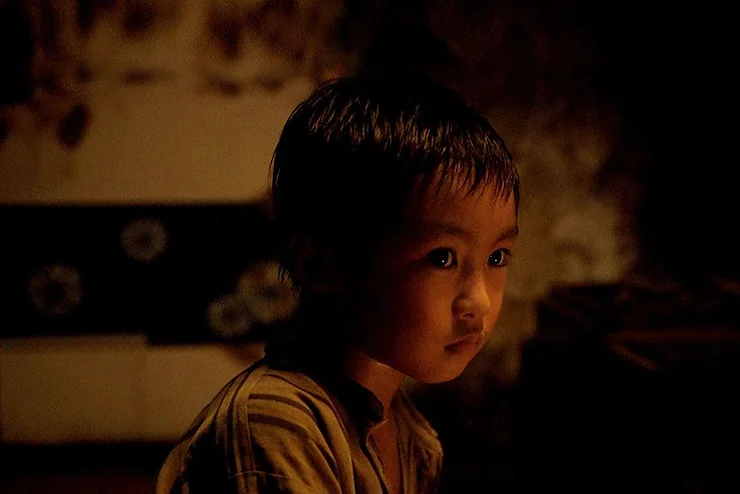
When the film’s perspective shifts, that sense of freedom takes on a different weight. The focus turns to Li (Shim Eun-kyung), a screenwriter who feels smothered by words. She retreats into pained silence instead, clutching her water bottle during a screening of her film, unsure how to respond to questions. It’s only when she turns toward images, lifting a camera to capture what’s around her, that something begins to shift.
That carries into her time with the grizzled innkeeper, Ben-zō (Shinichi Tsutsumi), whose presence feels almost bear-like in its unpolished way. There’s a kind curiosity to him, one that Li responds to. Their conversations remain awkward, but a gentle humour exists between them that makes the silences easier. The moments between them prevail as some of the most ordinary in the film, yet they matter more than anything they could say.
A wistful tenderness to Two Seasons, Two Strangers runs through these encounters. It returns, again and again, to people searching for connection without quite knowing how to express it. Yet, something is still said through the accumulation of moments. A precision exists to Miyake’s framing, particularly in his use of scale, that makes the characters feel small and overwhelmed when alone, yet quietly at ease when they are together.
Two Seasons, Two Strangers isn’t a film that reveals itself all at once. But in the days after watching it, I began to understand what defines it: the gentle humour beneath its awkward exchanges, the softness of its characters, and its intimate understanding of loneliness. There’s a beauty to the way Miyake frames each moment, one that gives the film elegance without losing its warmth. The film is warmer than it first appears, and in its own understated way, it understands the connection we all search for.