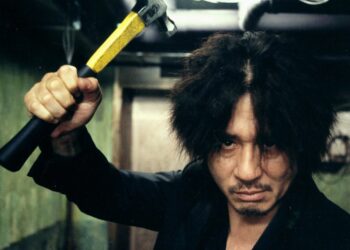
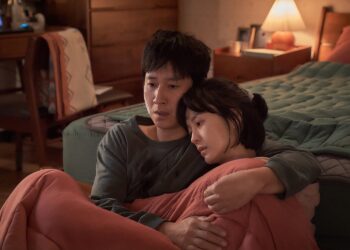
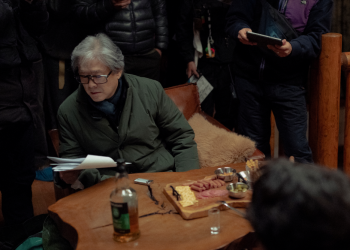
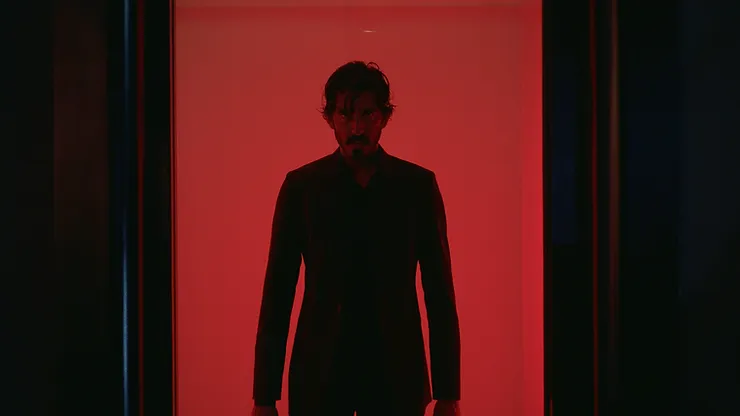
Green Fish is the debut directorial work of Lee Chang-dong. This 1997 neo-noir film follows recently discharged soldier Mak-dong (Han Suk-kyu) as he journeys into the criminal underbelly of Seoul while in thrall to a beautiful gangster’s moll, Mi-ae (Shim Hye-jin). However, his sense of loyalty to the mob boss, Tae-gon (Moon Sung-keun), shapes the trajectory of his fate.
While the film takes a heavy-handed approach to using traditional film noir tropes — from the emphasis on the alluring yet world-weary femme fatale to the random bursts of bloody violence in the dark and grimy city — it also adds themes of encroaching urbanization, broken family dynamics, and dangerous wish fulfillment.
Having grown up in a once-idyllic countryside, Mak-dong remarks early on upon the loss of trees and fields in Ilsan when he returns home after time spent in the military. The camera echoes this by lingering over the many new high-rises on the skyline as Mak-dong accompanies his younger brother at his job delivering eggs. Their humble family compound, with its single large tree on the town’s outskirts, is shown in stark contrast to the surrounding empty fields and threatening city in the background. This sense of urbanization’s looming inevitability becomes even more pronounced once Mak-dong moves to Seoul.


After listlessly trying to find work and witnessing his family’s various struggles (among them are poverty, shame, and alcohol addiction), Mak-dong stumbles upon an opportunity to work for Tae-gon, a gang leader and club owner. While Green Fish’s protagonist has some sense of morality that sets him apart from the other henchmen, Mak-dong is beguiled by Mi-ae, a glamorous yet tragic figure that he can’t help feeling drawn toward. Mi-ae is trapped in an abusive relationship with Tae-gon, however, the clever and ruthless Tae-gon also draws the restless Mak-dong under his influence with a sense of family loyalty and a dazzling dream of a better future.

Brotherhood is one major theme explored in Green Fish. Mak-dong’s oldest brother has a developmental disability that makes him child-like and unable to live alone or earn income. Mak-dong refers to him as “big brother.” Another older brother is a source of family shame as he is a drunkard who is often publicly scolded by his wife. Mak-dong also has a younger brother, sister, and mother — all of whom he wants to support financially.
Crucially, Tae-gon has his inner circle of thugs, including Mak-dong, address him as “big brother.” Unlike Mak-dong’s male blood relatives, Tae-gon is successful, powerful, and commands respect through violence, so it is easy to see why the unruly younger gangsters (one of which is played by Song Kang-ho!) look up to him. But the way Tae-gon ropes Mak-dong in for good and subtly corrupts the youth is by sharing his personal backstory.
It turns out that the suave and dangerous crime boss started from nothing and worked his way up the criminal ladder in relentless pursuit of a dream: to crush his enemies underfoot. Mak-dong also has a wish: to make enough money to keep his family under one roof instead of scattered and struggling. Green Fish takes a monkey’s paw approach to fulfilling that fantasy, climaxing in violence and betrayal.
Near the shocking end, a moving scene in a phone booth gives the film its title and becomes infamous upon the movie’s release in South Korea. Mak-dong calls his eldest brother, reciting a childhood story (improvised by the actor!) of hunting a green fish in the river and losing his slippers in the current. This happy memory is a precious one that Mak-dong clings to for comfort after committing a horrific murder. The titular green fish seems to symbolize a vision of the past that is as ungraspable as the fast-swimming creature.
What’s especially interesting in contrast is another scene set somewhere in the middle of the film. Mak-dong takes a break from his newfound gangster life to return home and join his family in celebrating their mother’s birthday. The large brood, which includes all the siblings, assorted spouses, and children, enjoy a picnic by a river under a bright sky. However, things quickly devolve into chaos and screaming as various arguments are sparked (somewhat akin to that episode in Season 2 of The Bear.)
In one way, the film seems disillusioned by Mak-dong’s dream of family unity. Would his family members be truly happy to live together again if they had the means? Can money solve deeper relationship problems? Mak-dong’s nostalgic view of the past, symbolized by the fauna and flora of nature — the antithesis of the corruption-filled city — seems impossible to restore as urbanization is on the verge of completely destroying the old way of life. Yet Green Fish leaves the viewer with the bittersweet results of Mak-dong’s actions, leaving us to wonder how quickly the contentment will slip away.
‘Green Fish’ screens at Metrograph in New York City on April 5 as part of the theatre’s retrospective series, Novel Encounters: the Films of Lee Chang-dong. Check out the official website for more details.