In Steven Soderbergh’s Presence, time folds in on itself. Like a mournful paper crane, a single timeline carries the weight of past and future, along with a fervent grasping for reconciliation. Hope stretches across temporal fabric with an energetic yearning that only Soderbergh, with his deft ability to telegraph dire urgency, could have managed. At once thrilling and poetic, Presence is a spellbinding modern ghost story.
The film, written by David Koepp, begins with an energetic preface. In a sort of macabre or defiled birth, we come-to in a barren closet in an equally barren home. The camera’s gaze — something more human, warmer, more pointed than the lens — emerges slowly from the closet and roves about a room with grand windows overlooking a narrow driveway. After surveying the room, the gaze, representing the titular, haunting presence, moves into the hallway and through the rooms on the second floor, before descending the lavish staircase and whirling through the first level. It’s all empty, the house bathed in the blue light of a springtime twilight. The first few moments are, in a way, an introduction to the home’s floor plan, but, more meaningfully, they are a panicked reckoning with emptiness.
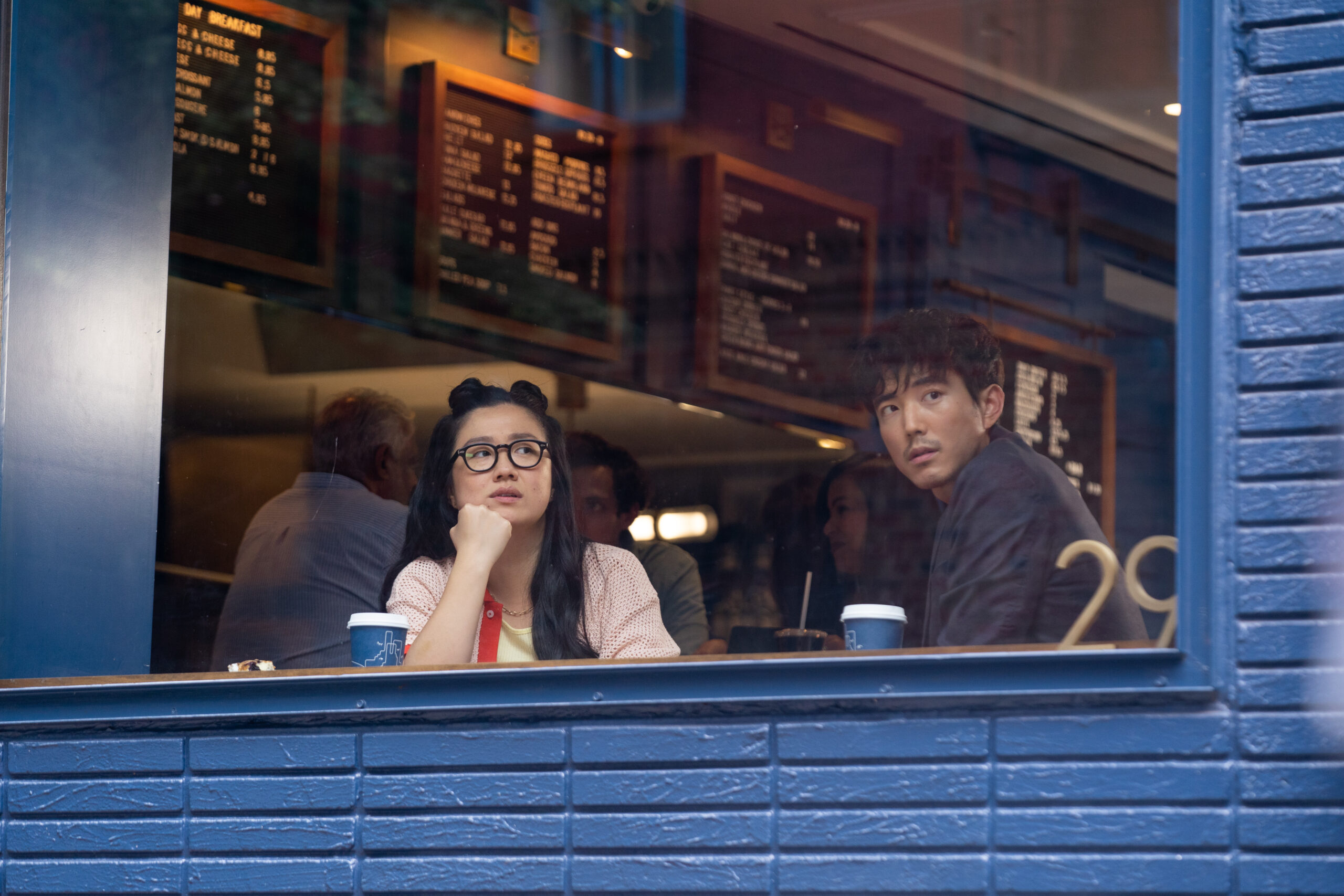
The preface fades to black and the film proper begins with a family — two teenage kids, Chloe (Callina Liang) and Tyler (Eddy Maday), and parents Rebekah (Lucy Liu) and Chris (Chris Sullivan) — moving into the house. The gaze observes from the room with the grand windows that becomes Chloe’s room. From the get-go, it is obvious that something is troubling the family. Rebekah works vaguely in the legal field and is a girlboss with a sinister arch. Always on the phone, she seems to be working on a business deal just this side of legal. Chris doesn’t ostensibly have a job and seems quietly exhausted by Rebekah’s work ethic, which is bourne of an apparent desire to do anything it takes to fund Tyler’s athletic ambitions. Tyler is a star athlete at school, and Rebekah dotes on him, letting slip during a drunken conversation with him that everything she is doing, no matter how morally questionable it may be, is for him and his future — this attention has spoiled him. Overly confident and unforgiving of weakness in others, Tyler is cruel to Chloe.

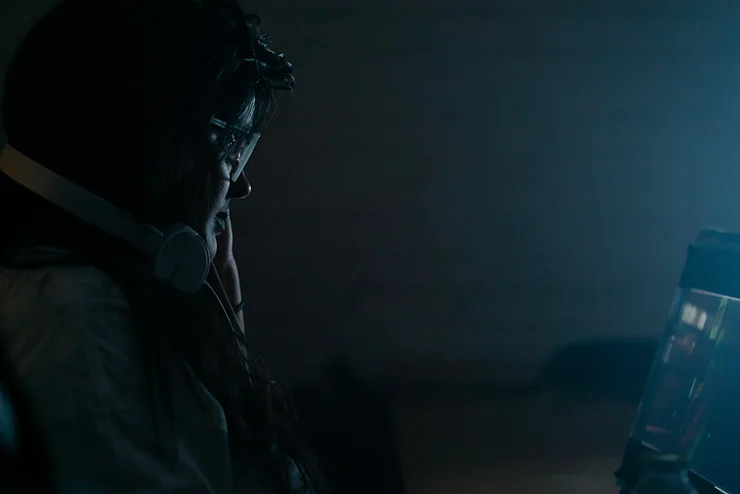
The younger Chloe, meanwhile, is, for the most part, neglected by their mother. Chloe has lost two friends to drug overdoses and is deep in a grief-stricken depression, spending hours in bed weeping. Soon, however, she begins to feel the gaze that watches her from her closet. And as she becomes increasingly convinced that her family’s new home is haunted by the ghost of one of her deceased friends, the presence itself nudges the family closer and closer toward a full-bodied confrontation with the thinly-veiled secrets lurking within their new home’s shadows.
It makes a certain amount of sense why some consider Presence to be a found-footage horror. Soderbergh tells the story from the first-person point of view, his lens serving as an invisible character’s gaze — and there’s the rub. Distinct from traditional found-footage films, Presence’s gaze is immediate, not mediated by a literal camera’s machinations, a camera whose presence is diegetically noted. What this means is that in Soderbergh’s film, we’re not being made to bear witness to horrors as is the case in a typical found footage film, whose narrative necessitates a camera and its sustained recording to document the horrific goings on. In Presence, we are in the eyes of the horror-making being. Soderbergh offers us something more nuanced than what we might expect from the first-person viewpoint, something more alive and immediate, an act more poetic than record-keeping.
Chloe is profoundly sad and actively grieving, and her tragedy is that her sadness isn’t respected by her mother, whose tenderness she so clearly needs. Chris, acutely aware of Rebekah’s coldness and Tyler’s meanness and intolerance of Chloe’s sadness, offers Chloe as much warmth as he can, often chiding his wife and son for their cruelty toward the grieving girl. Chris’s tenderness is carried by the camera’s gaze — it’s impossible to not feel the gaze’s yearning for connection with Chloe, a desire to reach out a hand and sweep a tendril of hair away from her forehead as she sleeps.
It’s not a sleazy or voracious look that the gaze here possesses; the watching through the slats in the closet door isn’t voyeuristic. Rather, the gaze feels loving, concerned, and protective, leaving us wanting to wrap Chloe in a warm embrace. Soderbergh has given his gaze a personality and sense of love, something few found-footage horrors, with their lenses tasked with the simple act of bearing witness, are capable of doing. In Presence, the camera does more than watch events unfold. It aches for Chloe; it shakes in anger when Tyler is mean to her, literally pounding with blood in its ears in a visceral embodiment of being wracked with anger, and it is riled with indignation and apprehensive fear when Tyler’s strange friend makes a pass at the vulnerable girl. The gaze feels alive like a person, more involved and careful than merely watching, more biased than bearing witness, with stakes placed in Chloe’s favour and against anyone who wants to harm her, including Rebekah. The gaze here is more observant and apprehensive than documentary, and this is Presence’s achievement.
The family depicted has a tear that is intuitively familiar, one Koepp doesn’t belabour, rightfully taking for granted our immediate understanding of Rebekah’s coldness and Chloe’s sense of aching futility. The familial dynamic is primordial, but delivered with a compelling edge. The characters, though generally sketched — as busy, working mom, perfect older brother, kind father, and moody, emotional daughter — are skillfully fleshed out by the actors. Liu and Liang have a swift but deep understanding of their characters, their unadorned but meaningful portrayals compelling enough to awaken visceral feelings of hate and care, respectively.
Koepp’s storytelling is efficient and unambitious, using archetypes with subtle twists, because he seems to understand the film’s visual project, leaving space for Soderbergh’s directorial vision: the whirling point of view of an impassioned soul. Scenes of sparse action are made tense by the frame’s pointed oscillation between rooms, from window to window, from face to face; the gaze is frightened and expectant, knowing and yearning. With preternatural grace, Soderbergh telegraphs a violently alive, furtively grasping, ghostly desire to do something, to help, to change the course of time.
Things don’t begin to come into focus until the film’s final few moments, but that very much is the point. About halfway through the film, Chris has a heart-to-heart with Chloe. Earlier, Chloe expressed to her family her belief that their new home is haunted, and Tyler was merciless, calling her crazy. The two screamed at each other with the unchecked and raw viciousness and ire that only family ever inspires. Chris tells Chloe about his own mother who he never got along with, in a similar way that Chloe doesn’t get along with Tyler. It was not until very near to her death that Chris finally was able to make amends, now living with guilt at not working more diligently in her lifetime to repair their relationship. Chris is talking to Chloe about regret at not having done enough, or at having let too much time slip by. Chris is talking to Chloe about wasted time, cautioning her against sustained acrimony toward her brother, against a tattered relationship with him. But the thing is, there’s no such thing as perfectly-utilized time. It’s impossible not to make mistakes, it’s impossible not to miss certain things — this film shows us as much. It’s tough not to want to stand up for yourself in the face of cruelty, whether it be from a brother or mother.
The fact that time was wasted is never apparent until it’s too late to do anything about it — we see this realization in the ghostly gaze’s shaky observations, in the time Chloe spends sleeping. It certainly is the case that a person can make efforts to savour the present, to make something good out of the minutes as they pass through us, as Chris is doing with Chloe by showing her his love, making up for Rebekah’s and Tyler’s coldness, but ultimately it is impossible to make meaning out of every second, it’s impossible not to leave life without guilt and regrets. It’s impossible not to live life without the shaking doubt, fallibility, and febrile angst that is the hallmark of humanity. It is only after the fact that one surmises one was not kind enough, not attentive enough, not good enough.
Presence depicts an active attempt to erase regrets, and in so doing, it reveals that such attempts are always circuitous, always leave one looping time in on itself, working and reworking things to try to make them perfect. Presence, in other words, depicts an endless and impossible task, and does so with the grace of a sonnet. This film is invigorating, clever, and gutting, things don’t make sense or matter until it’s too late, and even when it is too late, matters remain ragged and serrated, and that’s the point, because Presence is about a desire to live life itself.