An asset, and not a liability. This is how filmmaker Yoko Okumura now describes her perspective as a director. Of course, it took a long time for her to reach this artistic destination — 16 years, in fact — but she always knew making movies was her calling. It was simply a matter of knowing how to get there.
“I didn’t have any access to Hollywood,” she says in our Zoom interview. Indeed, Okumura was born in Kyoto, Japan and moved to Minneapolis with her family when she was five. Being Japanese-American, an immigrant, and, as she puts it, “a Midwestern girl,” Hollywood was the furthest thing from everything she and her family knew. “I never conceived that making movies could be a professional reality.”
It all started when Okumura received a video camera from her grandmother when she was 10 years old. From that moment on, documenting her life through cameras became an “obsession” and a love that she followed.
One of the biggest lessons she has learned is the inherent non-linearity of an artistic career. “You never get to a point where you’re like, ‘Everything is great. Now, everything is stable. Everything is awesome,’” she says. In fact, between major filmmaking accomplishments — such as signing with CAA (Creative Artists Agency) after graduating with an MFA from the American Film Institute, and directing an episode of Sam Raimi’s anthology series 50 States of Fright — there were times when Okumura worked as a server in a sushi restaurant in order to sustain herself.
Now, she is set to make her feature directorial debut with Unseen. What’s more, the film also marks the first Blumhouse production that is directed by a Japanese-American female filmmaker and features Japanese-American women as the lead characters. Jolene Purdy (The White Lotus) stars as Sam, a depressed gas station clerk who receives a random call from Midori Francis’s (Grey’s Anatomy) Emily, who is stranded in the woods, trying to escape from her murderous ex-boyfriend (played by Michael Patrick Lane). As Emily is nearly blind, Sam becomes Emily’s eyes via video call, and, together, they work to get Emily to safety.
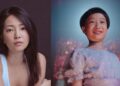
Written by Salvatore Cardoni and Brian Rawlins, Unseen was one of many features Blumhouse was interested in producing by the time it reached Okumura through her reps. “When you come on as a director, you want to make sure the script has an emotional core that you can really make personal, really make your own,” she says. “When I read that [Unseen], in the middle of being a wild thrill ride, was a story about two women forming an unlikely bond and friendship and saving each other in an unexpected way, I was like, ‘Okay, I can do that. That’s something I would love to make my own and put my stamp on.’”

Originally, neither Sam nor Emily were written as belonging to any certain ethnicity. It wasn’t until Okumura was onboard that cultural specificity was brought to the story. “It was actually a part of my pitch,” she says. Particularly for Emily, who is an ER doctor, Okumura wanted to make her Asian-American because of “how much Asian-American representation there really is in the medical field.” Meanwhile, Sam being Japanese-American was actually unintentional: Okumura had seen the first season of The White Lotus and immediately knew she wanted Purdy, who is part-Japanese, to play Sam.
Considering how Unseen features two Asian women being subjected to different forms of assault and violence, and the fact that this month marks the two-year anniversary of the 2021 mass shooting in an Atlanta spa that killed several Asian women, part of our conversation veers towards the political backdrop of Okumura’s film — of which she says that she, Purdy, and Francis were very much conscientious.
“I was very conscious of telling the story responsibly, making sure that what I’m representing here isn’t hopeless victimhood, but [a story] that’s incredibly empowering,” she says. “Both scenarios — Emily in a domestic abuse situation, and Sam surrounded by cops and strangers wielding guns against her — could be very real, [so] I knew that I had a responsibility to make sure that I was making something that made people feel hopeful about it.”
Indeed, the relationship that forms between Sam and Emily through the most adverse circumstances is perhaps the most notable element of Unseen. Even more remarkable is the process by which Okumura, her leads, and her crew captured the film’s emotional core, especially since the characters are never physically in the same space as each other.
“I got really lucky with Jolene and Midori,” Okumura says. She details how even though they shot each character’s scenes separately — Francis’ in the forest first, followed by Purdy’s in the gas station — both actresses were present during filming, performing as their characters off-camera for the other. For the actresses, this enabled them to participate fully in the growth of the story and their characters, which was of utmost importance to Okumura. “I wanted to make sure that, with Midori’s side being shot first, we didn’t lock into a version that Jolene wasn’t part of developing.”
In this way, the process of making Unseen, for Okumura, essentially became like shooting two movies in the amount of time it takes to shoot one. She adds, “On top of that, on top of the regular coverage with the cinema cameras, we’d also have to do the scene again with the phone cameras. So, it was really just the volume of coverage that was required across an expansive amount of time that [proved the most challenging].”
Okumura, of course, has never been one to shy away from challenge, as her career trajectory exemplifies so evidently. From Japan to Minnesota to Hollywood, between jobs on set and in restaurants, and from TV to film, she has built a career that has been exciting to watch. And now, she has fashioned a feature debut that proves why she deserves a seat at the table. “Every time I got a low point of like, ‘Maybe I can’t make it as a filmmaker,’ I would play a thought experiment. ‘What else would I be doing?’ The other options were never enticing enough for me to quit.”