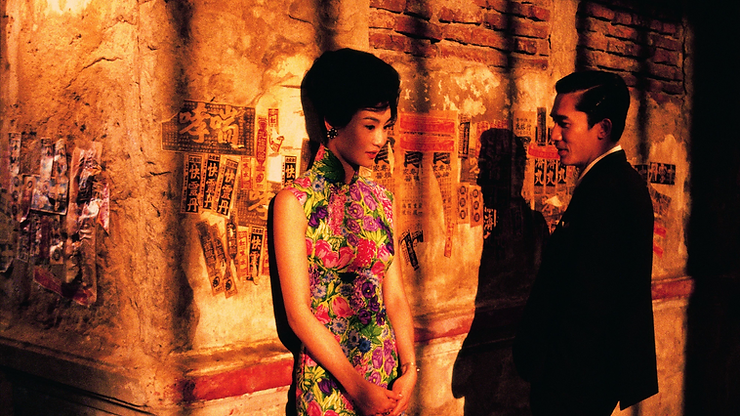
My formal education in film began 13 years ago with a Cinema 101 screening of In the Mood for Love, and at the risk of sounding hyperbolic, it changed the way I saw movies. It wasn’t that I hadn’t seen non-English, non-Hollywood cinema before — indeed, I can still recall taking the GO bus to downtown Toronto from the suburbs of my hometown in my early-teenage years, solely in search of international titles in DVD stores (when those were a thing) that weren’t available at my local HMV — but it was the first time I was in a room with dozens of other people, who wanted to be there, watching a movie that I, a lone film nerd in my household and circle of friends, would have otherwise screened by myself in my bedroom.
It wasn’t long before I plowed through other movies in Wong Kar-wai’s filmography, devouring Chungking Express, 2046, and Fallen Angels before my first year of undergrad was over. From there, I made my way through Tony Leung and Maggie Cheung’s works. But, for whatever reason, Happy Together always remained a movie-blindspot of mine — until now, that is.
Of course, it feels almost criminal to have watched Happy Together for the first time, 26 years after its initial release. Admittedly, the temptation to view it with a modern, historian lens was all too real, especially when you consider that we, in the last decade alone, have witnessed the independent-to-mainstream pipeline of LGBTQ+ storytelling. Throughout my screening, the larger question I couldn’t help but return to was: where does Happy Together fit into the larger picture of queer cinema, then and now? And its rebuttal: does it matter? Shouldn’t I just allow the film to exist as it is and judge accordingly?


As it turns out, this torn viewing experience yielded, for me, a most enriching screening of Wong’s film — and, by extension, most appropriate. Just as Lai and Ho’s time in Buenos Aires is, for each of them in multitudinous ways, a sort of limbo — living but not belonging, loving but not thriving, looking but not seeing — Happy Together itself is equally suspended in time, coming out just as New Queer Cinema as a movement was on the precipice of dispersing, making way for mainstream LGBTQ+ filmmaking. In this way, the film is a long-distant memory of a bygone era in both the most inspiring and most devastating of ways.
Happy Together follows young couple Lai (Leung) and Ho (Leslie Cheung), who move from Hong Kong to Argentina in search of a better life. However, being emotionally, culturally, and financially stranded in a foreign land puts pressure on their relationship. What ensues is an emotional — and, at times, physical — tug-of-war between the two, resulting in a vicious cycle of breaking up and getting back together, neither of them wanting to leave or let the other go, nor being in love enough to learn how to make things work.
One of the defining characteristics of a Wong Kar-wai movie is how mood is often its beating heart, dictating where the story will go next, who the camera follows, and what we’re allowed (and made) to see. This isn’t to say that any of Wong’s narratives are without structure, but, more than anything, we’re invited to feel rather than understand the story in its conventional sense. When it comes to Happy Together, the result is a deeply arresting experience, flitting back and forth between the brutality of Lai and Ho’s relationship and the wistfulness of, in Lai’s case, being a young man stranded in a foreign country, seeking, among many other things, connection and resolution (with Ho and with life itself).
A major part of why Happy Together feels as raw and rough as it does boils down to the chemistry Leung and Cheung exhibit on-screen. With just a glance, both actors are able to convey the storied history between their characters. This makes it nearly impossible to side with one over the other: both, on some level, are to blame for the constant friction in their relationship, but, at the same time, both are equally capable of tenderness. Even after all these years, very few queer relationships on-screen have come this close to capturing the forever-shifting power dynamics of love in a way that is honest without being grim, and entertaining without being melodramatic.
Considering the magnetism Leung and Cheung exude in the film, it’s a testament to Chang Chen’s performance as the third central character that he veritably steals our heart. Maybe it’s because, like us, he’s on the outside looking in, unable to resist Leung’s gravity and, seeing the heartache etched on his face, curious to know more. Maybe it’s because, like us, he’s moving through the world and making it up as he goes along. Or maybe it’s because, like us, he’s looking for something, but doesn’t really know what it is. Whatever the case, Chang’s presence elevates the film from being a stodgy domestic drama.
Indeed, what’s most remarkable about Happy Together is how alive it feels. Beyond Lai and Ho’s relationship, there’s an entire world in their pocket of Buenos Aires that is brimming with possible stories. Which is perfect for Wong’s propensity for a sort of “freestyle” approach to filmmaking: there’s a sense that he himself is searching for other stories within the one he set out to tell, turning his camera towards stray ends in the film, from substantial subplots like Chang’s detour to the end of the world to the briefest glimpses of Lai’s neighbours arguing with their landlord over rent.
Ultimately, yearning drives the film; whether it’s Lai and Ho wanting each other (but knowing they need to be apart), or their desire to finally go home, it’s the promise of another day, another chance, that keeps everything moving. Of course, Wong also unearths the precariousness of this promise, mining the fear, anxieties, and heartbreak that come with it. After all, we can never really know what the future might bring.
This makes it all the more satisfying when, at the end of the film, Lai is finally able to visit the Iguazu Falls before returning to Hong Kong. Interestingly, when Wong shows us the falls, it’s from a sort of bird’s-eye view rather than from Lai’s perspective — as if to say that we, too, made it to the end, to the place where we’ve always wanted to be. On one hand, there’s a bittersweetness to it: Happy Together is a singular film, and there will never be another queer film like it. But on the other hand, when you consider the grander history of queer cinema, and that we are lucky enough to live when it was made — and, now, see the ways in which it paved the road for other LGBTQ+ movies — there’s nothing more beautiful.