• About
  • Contact
  • Write For Us
No Result
View All Result
Donate
The Asian Cut
  • Home
  • News
  • Reviews
  • Interviews
  • Essays
  • Director Retrospectives
  • Home
  • News
  • Reviews
  • Interviews
  • Essays
  • Director Retrospectives
No Result
View All Result
The Asian Cut
No Result
View All Result

Cannes 2024: Filmmaker Constance Tsang Makes a Strong Debut with ‘Blue Sun Palace’

Jay Liu by Jay Liu
May 28, 2024
in Review
0
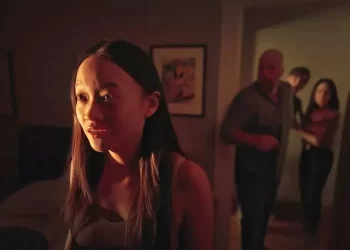
Wu Ke-xi as Amy standing next to a drying rack and laundry in Blue Sun Palace.

Photo Courtesy of Big Buddha Pictures / Field Trip Media

⭐⭐⭐⭐

Rating: 3.5 out of 5.

Constance Tsang’s directorial debut Blue Sun Palace was one of the most talked-about films in the Critics’ Week section of the Cannes Film Festival, taking home the French Touch Prize of the Jury. A recent graduate of the Columbia University School of the Arts, Tsang has secured the lead participation of Golden Horse Best Actor winner Lee Kang-sheng, best known for his career-long collaborations with slow cinema icon Tsai Ming-liang. Tsang’s film is best summarized as directorial-debut slow cinema, certainly with vision but not without certain flaws. It is nonetheless in many ways a rare, original breakthrough in Asian American cinema.

Set in contemporary New York City, Blue Sun Palace starts with a sweet date between middle-aged couple Cheung (Lee) and Didi (Xu Haipeng). Didi is a masseuse at a parlor with friend Amy (Wu Ke-xi), and she has dreams of opening a Chinese restaurant in Baltimore. But when tragedy strikes, the remaining members of the trio are uncomfortably forced to find strength in each other to rely on, all while trying to survive as immigrants in menial jobs.

Blue Sun Palace, directed by Constance Tsang
Photo Courtesy of Big Buddha Pictures / Field Trip Media

The strengths of Blue Sun Palace are immediately obvious in the first scene. Instead of traditional shot-reverse shot coverage, Tsang shoots the date between the lovebirds in a roving handheld-camera long take. This naturalistic style requires so much authenticity from the performances and dialogue, and Tsang certainly shows stylistic confidence abound. The problem arises, however, when she basically repeats this strategy in every scene afterwards. While it is beautiful throughout and works superbly well for certain moments, it feels like an aesthetic strategy for the sake of having a strategy, instead of judiciously curating the film’s cinematic language to what the story needs.

RelatedStories

Lexi Perkel as Callie and Judy Greer as Mrs. G standing together inside a greenhouse in Mabel

‘Mabel’ Is Poetry in Motion

Riz Ahmed as Shah Latif prepares to audition for James Bond in Bait

Riz Ahmed as 007, Bruv? That’s ‘Bait’

That being said, on a thematic level, there is much to like. Once again, the first scene shows a middle-aged couple in love like teenagers, and that brand of romance is so rare in cinema — especially in Hollywood, it’s almost as if only hot, young people are allowed to be in love. By aging the characters in their 40s and 50s, Tsang has automatically introduced much more subtext to the central relationships in her film: they come into their relationships with histories, regrets, and other baggage. The cast forms untraditional screen couples, especially for Lee, who has never been a conventionally heroic leading man, yet all the more intriguing and inviting by receding into his husk.

The other commendable aspect is how Blue Sun Palace operates as an immigrant story. Identifying as a Chinese American, Tsang has presented an Asian American film unlike the kind of AsAm stories that have proliferated the media landscape in the past few years. The main characters of Blue Sun Palace aren’t struggling 30-year-old hipster artists; they aren’t trying to appease their traditional parents; they aren’t even trying to assimilate. To them, America is simply a place to survive from one day to the next; Tsang isn’t even interested in an illusion or the suggestion of an American Dream. At an age when Asian American artists seem to have very limited stories they can tell, she has broken new ground here and shown another convincing reality of Asian Americans so far underseen.

Even though the conditions for our characters can get traumatic, neither is Tsang interested in the Euro-realist suffering porn all too often seen at Cannes by directors like, say, Ken Loach and the Dardenne brothers. Tsang simply depicts life as it is: in real time; no exploitation or judgment involved. In terms of style, the filmmaker still has some further refinement to do, but in terms of thematics, she may have latched onto something uniquely hers. Her tone is certainly special, accomplishing the most important thing a directorial debut needs to do: nailing her voice and making your mark on the film scene.

Now Streaming On

JustWatch

The Review

Tags: Blue Sun PalaceCannes 2024Cannes Film FestivalConstance TsangUSAXu Haipeng
ShareTweet
Jay Liu

Jay Liu

Proudly hailing from the embattled city of Hong Kong, Jay Liu tells stories of queer romance and domestic realism. He is a recent alumnus of the USC School of Cinematic Arts with an MFA in Film/TV Production. His thesis film, “Anywhere the Wind Blows,” has been selected by festivals like Los Angeles Asian Pacific and the American Pavilion Emerging Filmmakers Showcase at the Cannes Film Festival. He also writes about film and culture, with bylines in Collider, Cinema Escapist, and USC x Cannes Classics. He is an alumnus of Northwestern University.

Recommended For You

Awkwafina as Katie Kim staring at a lottery ticket in the movie Jackpot.
Review

Awkwafina’s ‘Jackpot!’ Prizes Bored Indifference

A medium close-up portrait of Jeremiah Abraham, a Filipino man wearing black glasses and a tan jacket.
Interview

Tremendous CEO Jeremiah Abraham on the ‘Situationship’ That Changed His Life and Career

October 17, 2024
Split shot of Alice Wu's Saving Face and The Half of It.
Essay

From ‘Saving Face’ to ‘The Half of It’: Wrestling with Shame and Desire Across Time

November 24, 2023
Wanlop Rungkumjad as Oom, standing in a hospital hallway with a bloodied face, in Mongrel.
Review

Cannes 2024: ‘Mongrel’ Is an Unfortunate Case of Style Over Substance

Izaac Wang Chris Wang and his family, Chang Li Hua as Nai Nai, Joan Chen as Chungsing Wang, and Shirley Chen as Vivian Wang, sit at their dinner table in Dìdi (弟弟).
Review

Dìdi (弟弟) Is Unruly as Pubescence Itself

Michelle Yeoh in American Born Chinese.
Review

‘American Born Chinese’ Mashes Up Modernity and Mythology

Next Post
Mahsa Rostami as Rezvan blind folded and holding a piece of paper above her head in The Seed of the Sacred Fig.

More Than a Masterpiece, 'The Seed of the Sacred Fig' Is Activism in Real Time

Popular Stories

Machiko Washio as Washio Midori in The Red Spectacles

A Tonal Labyrinth and the Freedom of the Absurd in ‘The Red Spectacles’

Looking into The Queer Mirror of ‘Mulan’

Looking into The Queer Mirror of ‘Mulan’

2 years ago
Robert Pattinson as Mickey Barnes in a space suit, holding his helmet in a snowy landscape in Mickey 17.

‘Mickey 17’ Has Bong Joon Ho Written All Over It 

Film still from Plastic, directed by Daisuke Miyazaki.

‘Plastic’ Uses Music to Capture Youthful Nostalgia

Hokage, Shadow of Fire movie

Venice Film Festival 2023: ‘Hokage (Shadow of Fire)’ Brings To Light The Shadows of War

  • About
  • Contact
  • Write For Us

Copyright © The Asian Cut 2026. All rights reserved.
Privacy Policy | Terms of Use

Welcome Back!

Login to your account below

Forgotten Password?

Retrieve your password

Please enter your username or email address to reset your password.

Log In
No Result
View All Result
  • Home
  • About
  • News
  • Reviews
  • Interviews
  • Essays
  • Director Retrospectives
  • Write For Us
  • Contact

Copyright © The Asian Cut 2026. All rights reserved.
Privacy Policy | Terms of Use