Vittorio De Sica’s post-war drama Bicycle Thieves has retained its urgency because the film finds the human bone beneath a social wound without turning pain into spectacle. Every era seems to spawn a new attempt at that balance; last year I watched Anywhere Anytime at TIFF and noted how it traced similar narrative seams.
Lloyd Lee Choi’s Lucky Lu lands in that lineage, a contemporary riff on the thief-and-bike template, and the question it quietly asks is: “Why revisit that shape now?” The answer here lies mostly in performance and feeling rather than in reinvention.
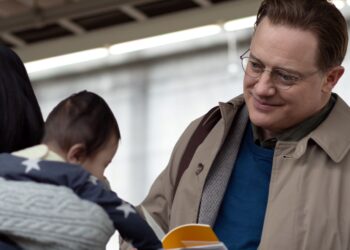
Lu (Chang Chen) is a quietly ambitious immigrant in New York who’s finally scraped together enough cash for a small apartment flat — “A new place. A new beginning,” the landlord says — and is days away from seeing his wife Si Yu (Fala Chen) and daughter Yaya (Carabelle Manna Wei) arrive from China. The film compresses time into a pressure cooker: in a cruel rearrangement of fortune, his rented e-bike — his livelihood in the gig economy — is stolen.


To make matters worse, the friend who promised him the apartment had no right to do so, taking the deposit payment with him. What follows is a day of small humiliations and makeshift hustles as Lu tries to stitch together another plan before his family steps off the plane. You can assume at this point that the “lucky” in the title feels ironic, given the unlucky streak Lu has found himself in.
Choi doesn’t dress the story up. Norm Li’s camera follows Lu close, sometimes so close you can feel the strain in his shoulders. The film updates De Sica’s basic moral knot for app-driven times: the bicycle becomes an e-bike, and that beep of a new delivery order is now the modern taunt. This is not mere transposition for novelty’s sake; the e-bike is a tidy, painful metaphor for precarity — mobility that promises independence but is rented, regulated, and revocable at the tap of a corporate thumb. Watching Lu see other couriers pedal past him, phone chiming alive with orders he can’t take, is a kind of contemporary cruelty.
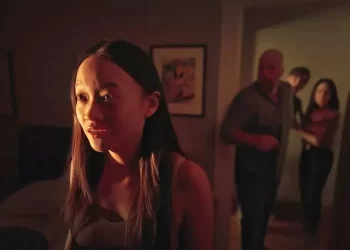
Chang supplies the film with its heart, giving Lu a dignity that never tips into self-pity. He hides panic behind practical gestures, and when he stumbles into moral compromise, you understand the arithmetic of his choices. Opposite the actor, Wei is a revelation as Yaya. Electing to tag along with her father without nary an idea what predicament he has put himself in, Yaya channels Bruno Ricci with an unforced clarity, the little interruptions of childhood that make Lu’s desperation sharper because it is for her sake. These father-daughter scenes are where Lucky Lu is at its most humane.
Thematically, Lucky Lu boasts of generous moments of quiet craftsmanship. For one, Choi stages the city as a character — claustrophobic stairwells, the wash of neon, the communal indifference of strangers. On the other hand, the film’s sound design, from the whirr of delivery apps to the clack of traffic, does a lot of the emotional shaping without melodrama. When the story leans into more theatrical beats late in the running time, it flirts with overwriting; yet even that misstep contains a sincerity that rescues the risk.
My issues (and there are a few) are less with intention than with shape. The middle loses some narrative momentum: scenes that escalate tension early are followed by stretches where the film seems to wait for the next obvious beat rather than inventing one. Moreover, the film merely sketches in supporting players where they might have had deeper characterisations. Chen’s Si Yu, in particular, registers as a powerful presence yet gets fewer interior moments than the story asks for. These are not fatal flaws, but they’re the places where the film’s ambitions meet the realities of a compact debut.
As noted at the outset, I found myself thinking about Lucky Lu alongside other recent films that borrow Bicycle Thieves’ blueprint. Some replace antique Rome with new cities and find the story hollow. Others, like this one, justify the return by reframing the machine of survival for a gig economy that is structurally different but emotionally familiar. Choi isn’t just updating De Sica for the age of delivery apps; he’s locating the story inside the specific texture of Asian immigrant life in the modern United States.
Lu’s struggle isn’t an abstract parable about work; it’s the daily calculus of someone who speaks a second language, who left a family behind to build a future they can join, and who knows that every small failure will ripple back across an ocean of expectation. The stolen e-bike becomes more than a stand-in for a bicycle: it’s a fragile link between two worlds, the means by which a man proves, to himself and to the relatives waiting on a plane, that the sacrifice of distance was worth it. When Lu is brushed aside by customers or nickel-and-dimed by an app that treats him like a replaceable cog, the film quietly folds in the long history of Asian labour in America — visible when convenient, invisible when not.
Ultimately, if the film sometimes telegraphs where it’s heading, it doesn’t blunt the ache. Lucky Lu doesn’t make a spectacle of suffering. It insists instead on the small dignity of a man doing what he can, and in that insistence it finds its voice. For viewers who respond to character-first cinema about the costs of making a life in a city that constantly recalibrates who belongs, Choi’s debut is worth your time. It won’t rewrite the rulebook, but it will make you watch one man try to keep his promise — and that, on its own, is enough.