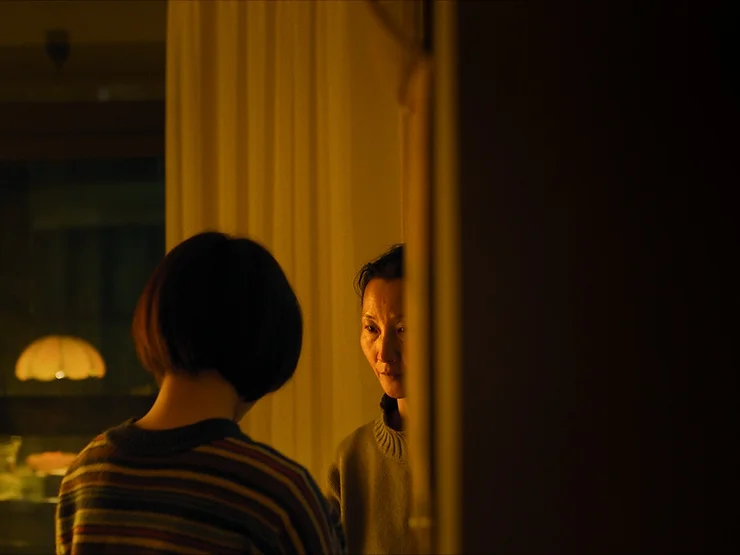
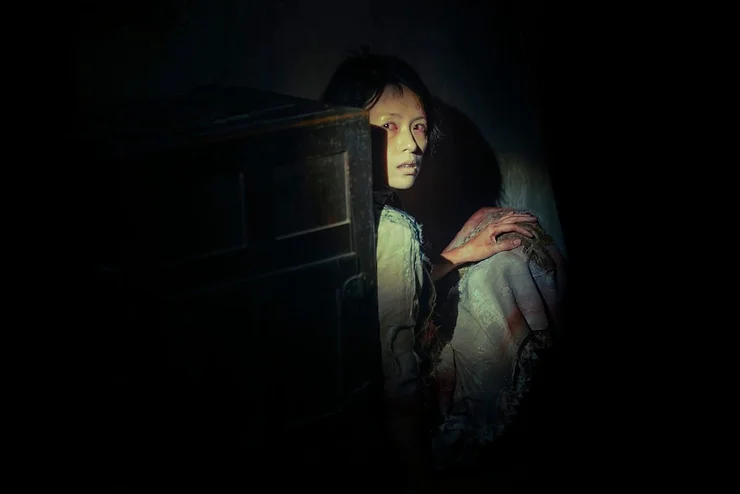
In Only the River Flows, (Chinese: 河邊的錯誤), Wei Shujun’s adaptation of acclaimed author Yu Hua’s 1998 novel, the conflict between its protagonist’s desire for meaning and the indifferent world surrounding him permeates throughout the film. By beginning this Chinese noir with a quote from Albert Camus, Wei prepares the audience for what’s to come. And as the main character delves deeper into his investigation, Only the River Flows touches upon existentialist philosophy, an exercise that involves the active pursuit of meaning – amidst everyone else’s resignation to a lack thereof.
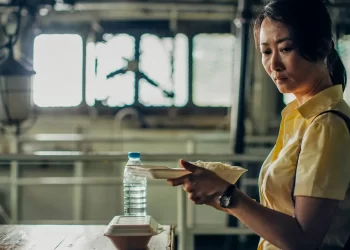
Almost entirely shot on 16 mm film (Zhiyuan Chengma’s cinematography here deserves praise), Only the River Flows is set in Peishui, Jiangdong in December 1995. We see Ma Zhe (Zhu Yilong) getting an assignment from the chief of police to work on a case involving a series of murders in the riverside town. As the chief’s favourite, Ma gets a new office as well – a recently closed local cinema, enough for Ma to continue his work in the main projector room upstairs and the theatre’s spacious stage.
The latest victim, an old woman called Granny Four, was found by the river with no signs of foul play. On the surface, the case seems straightforward, with a simpleton Granny Four had taken in, known to the townsfolk as ‘the madman’, being the main suspect.

Wei, however, has other plans in mind apart from making this a smooth-sailing crime film. As Ma finds out early on, something doesn’t add up. A satchel was found by the riverbank, containing a cassette tape with a woman’s voice heard on it. Chasing this lead steers him to a secret relationship between a student and her teacher. This lead, in turn, leads to another person of interest, a rabbit hole of investigations that yields interesting discoveries.
Ma’s interviews with the locals include eyewitness accounts about the sighting of a woman with wavy hair, a young boy who found Granny Four’s body, the victim’s neighbours recounting their dealings with the former as quite friendly, and a hairdresser too eager to be apprehended for the crime. While an arrest of a different suspect is quickly made, an unconvinced Ma refuses to close the case, much to the chief of police’s chagrin. Ma’s obsession to find a logical explanation threatens to consume him and his personal life, lest he fails to confirm who the killer really is.
To Wei’s credit, Only the River Flows is a streamlined adaptation of a densely complex and morally ambiguous source material, although a case can certainly be made for moral ambiguity and its suitability to the noir genre. By renaming the title from Mistakes by the River to Only the River Flows, Wei shifts the focus from the theme of human fallibility of the townspeople to a broader commentary on the ever-changing society as symbolised by the continuous river flow. Even so, the film’s plot becomes a little muddy at times, exacerbated by a runtime that frankly could have used some reduction to make for leaner pacing.

To complement the narrative of his film, Wei – himself a child of the 1990s – makes use of the sociopolitical climate of 1990s China. During this period, the country witnessed the growth of collectivism, increasing levels of corruption and unemployment, environmental challenges, and the controversial one-child policy. In fact, in 1995 (the same year the film was set), the Chinese government explicitly warned against abortion as a means of family planning. This becomes important in portraying Ma Zhe’s deteriorating psyche, as his personal life and the investigation begin to merge in his mind. His wife Bai Jie’s (Chloe Maayan) high-risk pregnancy presents a looming likelihood of raising a child with birth defects, and the couple are butting heads over terminating the pregnancy.
With these subtexts, Wei makes use of disorientation to blur Ma’s vision of what’s real and what’s imagined. Zhu Yilong – who gained weight in preparation for the film and then lost 55 pounds as the shooting went on – portrays Ma with a fragile sense of humanity that makes it easy for audiences to latch onto. His performance is evocative of a young Tony Leung Chiu-wai in his ability to express breviloquent apathy, emotional investment, and insanity all at once.
While all these speak of Wei’s smart filmmaking choices in play, Only the River Flows also suffers from the director’s over-eagerness to provide commentary through its numerous metaphors. Aside from quoting Albert Camus, the film’s opening sequence shows a small boy playing cops with his friends during one rainy day. As he progresses through the rooms of an abandoned house, he opens a door that turns out to be a multi-storey house about to be demolished. There’s also Ma’s dream that melds reality and fantasy, culminating in a murder that may or may not have happened at all.
The film’s final scene, completely embracing its ambiguity and symbolism by this point, feels rushed and undeserved. That final shot punctuates Camus’ philosophy of “There’s no understanding fate; therefore I choose to play the part of fate. I wear the foolish, unintelligible face of a professional god.”
Even so, I’d like to wager that it’s what Wei really intended; and in a way, that feels right.