Part and parcel of Rosencrantz and Guildenstern’s plight in Rosencrantz and Guildenstern Are Dead (the Tom Stoppard play and his own 1990 film adaptation) is a lack of meaning within a deeply structured and rigorous plot, a need for guidance and care in face of the indifference of playwrights Shakespeare and consequently Stoppard. These extraneous but crucial men, Rosencrantz and Guildenstern, amble about Stoppard’s play waiting for their lines in Shakespeare’s Hamlet, killing time as they creep closer and closer to their deaths, their existential dread growing with every one of their meaningfully meaningless lines. I mention this because Martika Ramirez Escobar’s Leonor Will Never Die offers a world in stark contrast to, but also inevitably linked with, the one offered to Rosencrantz and Guildenstern, one kinder to and deeply alive with caring for its fictional characters.
Escobar writes and directs Leonor Will Never Die, but it also is the case that Leonor herself (Sheila Francisco) writes and directs Leonor Will Never Die. Leonor Reyes is a retired film writer who, in her heyday, received much renown for her action films. She is deep within a writing project when a TV, carelessly thrown out of a window, knocks her into a coma. She awakens within her own unfinished screenplay wherein Ronwaldo (the enigmatic Rocky Salumbides) must protect his town against a corrupt mayor. As Leonor trails after Ronwaldo, increasingly becoming the protagonist in his tale, in the real world her fretful son Rudy (Bong Cabrera) attempts to figure out how to bring his mother out of her coma, believing that if he produces the screenplay Leonor was working on when she was knocked out, she might awaken.
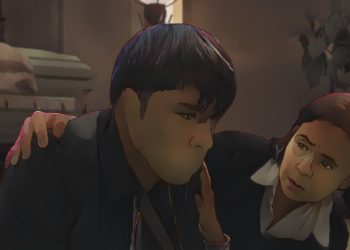
One of the most (out of many) mesmerizing scenes in Leonor Will Never Die is when Ronwaldo’s mother speaks about the death of Ronwaldo’s other brother at the hands of Ricardo (Ryan Eigenmann), the mayor’s son. Ronwaldo’s mother softly tells Leonor how difficult it was for her to lose her son, how she took it especially brutally, and is perhaps not yet fully healed from the loss. Leonor is at a loss for words and she tearfully apologizes to Ronwaldo’s mother for bringing them pain through her writing. Leonor then goes on to share her own story with her character, telling Ronwaldo’s mother about how her other son, Ronwaldo (after whom she certainly named the action hero Ronwaldo), was killed on one of her sets: a real, loaded gun was mistaken for a prop gun.


A few scenes later, we near the point at which Leonor stopped writing the screenplay due to her injury. Ronwaldo’s love interest, Isabella (Rea Molina), is kidnapped by the mayor’s henchmen. We see Ronwaldo through an overhead tracking shot, running to save Isabella. But suddenly, Ronwaldo stops, suspended in time, in timelessness because the script has run out of directions. Ronwaldo stands there, for a moment starts discoing, and we hear the clacking of a keyboard. Leonor writes her scripts on a typewriter, this clacking is not her unmistakeable pings. The keyboard clacks are Escobar’s own, a flurry of keys working to figure out what to do next with Ronwaldo and Leonor.
It’s certainly funny and deeply entertaining the many turns Leonor Will Never Die takes in its parody of Filipino action films, the hamminess of the over-the-top dramatic dialogue that Leonor is so adept at writing. But there’s something additional, something deliciously meta, that makes this movie one of the year’s most spectacular achievements, which the two scenes I described above demonstrate. Leonor Will Never Die is perhaps the most compellingly philosophical and headily playful films in recent years; not pretentious or contriving to shellac on the veneer of prestige. Rather, this movie is jaw-droppingly unassuming in how incredibly well thought-out it is. In other words, Escobar makes a scrumptious meal of the effort, mental and physical, it takes to create a film; she doesn’t make a show of eliding the effort it takes to make movies and make movie magic.
Stoppard, with his avant-garde Rosencrantz and Guildenstern Are Dead, dramatized the effluence of fear and angst in the face of the relentless onslaught of an uncaring plot written by an author who sees his characters as simultaneously crucial for the plot’s movement, and also dispensable, their rich inner lives negligible. Escobar, meanwhile, shows us what it looks like when a writer returns immense care and sympathy to her characters, many of whom she’s put through the physical and emotional wringer; she shows us what it looks like when the writer is perhaps much too loving, inextricably emotionally invested. Escobar’s and Leonor’s is the handling Rosencrantz and Guildenstern would have wanted, the warmth and tenderness that might have cushioned them against the blunt strictures of their fates.
Leonor Will Never Die, in comparison to Stoppard’s endeavour, is soft and fluid; this movie is caught in a rich and endless ebb and flow of becoming and unbecoming. Escobar takes up crucial space within her movie, too, speaking near the end of how Leonor’s and Ronwaldo’s stories could go on endlessly, that there is perhaps no right or proper way to finish a film, especially in face of a writer like Leonor who self-corrects and revises simply because she can. There is so much plasticity here, no pull of the finality contained within something like Rosencrantz and Guildenstern Are Dead. This movie is an endlessly beguiling paradox, with nothing ever fixed, despite its being within something so interminably fixed as the package of a film — 99 minutes of runtime.
Leonor will never die, will never be confined by any eventuality, while Rosencrantz and Guildenstern will perennially be dead, will always hurl toward that singular fate. With Leonor Will Never Die, a film as groundbreaking as Stoppard’s play was, Escobar stunningly adds to a conversation philosophers and writers have been grappling with for years. While Stoppard pointed to the sapping confines of plot, Escobar shrewdly shows a way of filmmaking rich in possibility and also in compassion, and thereby shows herself to be one of the most exciting filmmakers working today.
Leonor Will Never Die is certainly endlessly watchable for the giddy joy it takes in parody, for how much fun literally every actor and character on screen seems to be having taking up cinematic space. It’s also certainly endlessly watchable for all the various epistemological, existential, and compositional questions it raises. That Escobar is able to endow her work with all these enigmatic pulls as she sets before us the story of an artist who desperately needs her art to heal, an artist who is as much consumer of her art as she is its creator, one who weeps as she works, is what makes Leonor Will Never Die revolutionary.