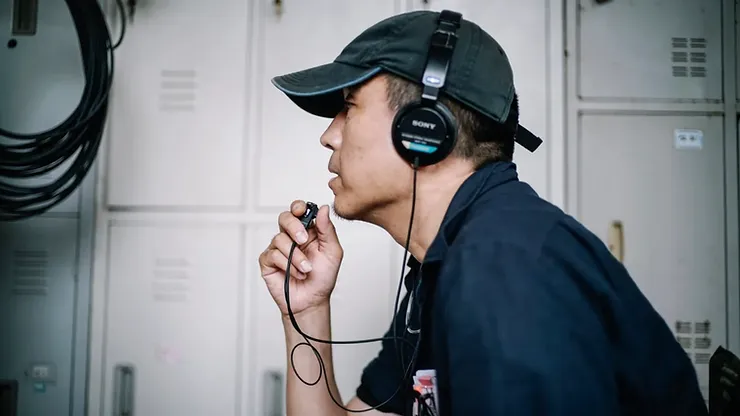
“I think you need to step out and go back in to see the absurdity of it,” writer-director Siyou Tan tells The Asian Cut.
Around the world, Singapore’s utopian-like image sits in stark contrast to the seeming disorder of other nations. From gun violence and petty theft to never-ending construction projects and constantly delayed trains, Singapore — government and most citizens — have held their country up above these destructive qualities.
But all that glitters isn’t gold and Tan’s directorial debut, Amoeba, provides an additional perspective of Lion City.
Set inside an elite all-girls school in Singapore, Amoeba follows four classmates who connect with one another in the name of rebellion. Unwilling to follow the status quo, Choo (Ranice Tay), Vanessa (Nicole Lee Wen), Sofia (Lim Shi-An), and Gina (Genevieve Tan) pledge allegiance to each other, rather than city and state.
Over Zoom, Tan explains that her initial idea for the film focused on the coming-of-age of a group of girls during their formative years, reflecting the filmmaker’s own friendships while in school. Tan, who now lives in Los Angeles, found herself evolving the original premise to explore her birth country’s coming-of-age.


“Singapore is young and it’s still struggling with the things that teenagers struggle with,” she observes. “The sense of identity, who we are, control, and all that kind of thing.”
Tan acknowledges that her distance from Singapore has contributed to her being “a little more critical of certain things, [like] the liberties and the freedoms that we are made to give up for the running of the country and the smoothness and the efficiency.”
“It’s nice that the trains run [on time], but what do we give up?” she neatly summarizes.
In retrospect, Tan sees the daily assemblies she was made to participate in school, wherein students are asked to “put our hands on our heart and pledge our allegiance and loyalty,” as an effort to create a subservient country. “In school, everything, your life, is about the country. If it’s good for the nation, it’s good for you.”
“I didn’t really have individuality or [an] identity,” she says, “and our growth and our paths are all driven to the national project.”
Amoeba, which had its world premiere at last year’s Toronto International Film Festival and was released in Singaporean theatres this month, sees Tan navigate an alternative personal history. What if she had moved away from the national project as a teen?
“I had to unlearn [things] about myself,” explains Tan. “The indoctrination is so strong that I’m not aware that I’m giving something up.”
She continues, “‘That’s the way it is,’ is really the Singapore attitude. We can go on holiday, so everything is good. I think people are not aware.” When Tan brings up concerns of privacy, for example, to her fellow compatriots, they respond with a dismissive, “You’ve become so American.”
In making Amoeba, Tan creates a self-referential, almost meta, situation. The film, in part funded by Singaporean investment, takes aim at the national project; but its mere existence (and subsequent theatrical release in the country) suggests the national project may not be as restrictive as Choo and her friends confront in the film.
Arguably, though, this is by design. Tan is aware of the quick-draw nature of censorship in her country, and purposely made Amoeba such that it would pass muster according to film classification guidelines.
By “kind of using this—not a disguise, but the superficial thing of, coming-of-age of teenagers to explore the deeper questions about control, authority and insert a bit of subversion in there as well,” Tan found a way to question the powers that be and still work within their system.
While censorship tends to be the main focus when discussing the Singaporean film industry, Tan considers the nuts and bolts of what drives decision-makers as well. She opines that Singapore sees the arts as something akin to a business case: “Let’s study it, let’s see what the return on investment is, let’s write a paper.”
For a time, Singapore did see some potential value and did invest in their filmmaking sector, but, as Tan says, “it’s not returning enough investment. Video games and AI are a little bit more lucrative.”
At present, Tan recognizes the shortcomings of her home country, especially as it pertains to allowing arts and culture to flourish: “I think they [Singapore] don’t want to give it the freedom that it needs, because that means relinquishing control and potential chaos, and also people questioning the national narrative. Somehow they think that this means everyone’s going to revolt, which is totally not true.”
In spite of her misgivings, Tan believes “there’s reasons for me to be hopeful, primarily because of this youth energy,” commending the next generation’s desire to explore culture, art, and music.
However, a shift in societal perception needs to change.
Tan shares a conversation she had with her sister and brother-in-law, discussing whether or not they had gone to watch a particular Singaporean movie. Disappointingly, their response was a point of confusion: why watch a locally-made film when you can pay the same ticket price and watch something made with a higher budget? (Presumably a splashy Hollywood picture.)
“Even your movie-going choice is financial!”