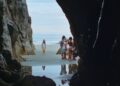
With rocks and stones as a textured canvas, Mongolian-Canadian artist Alisi Telengut paints vivid imagery of Lake Baikal, a stunning freshwater lake located in the Republic of Buryatia. Telengut used a variety of Canon cameras, securing them overhead to capture landscape transitions between lakes, mountains, and a volcano as Marina Dorzhieva provides a calming voice-over.
As the visuals change, Dorzhieva recites words in a dialect of Buryat that is becoming less and less understood. While Telengut creates stunning stop motion animations with natural elements that pre-date our existence, Dozhieva’s voice echoes of a language slowly being lost to time.
Telengut’s short film is hypnotic, grasping onto our senses as we vacillate between admiring the colours and artistry, and hearing words foreign to our ears. We try to find connection between the sonic and the optical; a connection that somehow feels human and grounding.
The Asian Cut caught up with Telengut from her home in Montreal after her Sundance premiere and explored her inspiration and artistic vision for her short film, Baigal Nuur – Lake Baikal.

This interview was edited for length and clarity.


TAC: How did everything go at the Sundance premiere?
Alisi Telengut: I was super happy. The premiere was at an Egyptian theater. The first screening [was] a mixed crowd. There were lots of press people. The second one was more general public in Salt Lake City. There were lots of university students, too. It was nice; lots of good questions.
What about Lake Baikal inspired you to make this film?
I think there are mainly two reasons. The first one, I heard about the lake from my mother. She’s been there many times and I’ve never been there. It’s the oldest freshwater lake in the world, the deepest. It formed around 25 million years ago. So at the beginning, I was really fascinated because in this area it’s just a plateau and all of a sudden, in the middle of the land, there’s a rift lake, and it’s the deepest freshwater lake.
The second reason [is] because my mother tongue is Mongolian. The Indigenous people living around this area, they’re called Buryat, and they speak a dialect of Mongolian. So I’m interested in this connection of the languages. At the beginning, I didn’t know that their language is severely endangered, I just knew it was endangered. But then during the process of making the film, at the end, I realized that the language is very endangered.

I found there to be an interesting comparison between using images of a lake that has existed for 25 million years, and will continue to exist when all of us are gone, with a dying language that may not exist at all in 100 years. Could you talk about those contrasting devices?
Wow, that’s a wonderful comment and reflection, thank you. I was very interested in this human-nature relationship from the Indigenous people’s perspective. They are deeply connected with the land they are living on and the human and non-human are very deeply intertwined. For example, in Marina’s [narration], at the end, she said a word which means “swan” because this particular word will be only used from her clan. In Buryatia, there are many tribes and clans, and this word will be only used in her clan to describe her ancestors, because she said her ancestor is a half-human-half-bird. So I found this relationship between human and non-human very interesting — it’s very embedded in their languages and vocabularies and worldview, I think.
I know that the words Marina chose were ones she could remember in Buryat, but did you give her any words that you specifically wanted or were there any words you hoped she would use?
Yes, I give her a list that I could think of — for example, “volcano” — because I know that the lake is a rift lake and there were volcanic activities many years ago. So I gave her a list such as “mountain,” “walking,” etc. and she added more. Especially when she [talked about] the human-bird, which means “swan.” This one, I really had no idea about.
I’d like to go back to what you said about the connection the Indigenous Buryat people have with nature. It reminds me of animism, which is an idea many Indigenous cultures embrace around the world.
Yes, I have been interested in the subject of animism also in my previous work as well. [This film] is like a continuation of the same theme, I would say. And then I learned that the Buryat language has become very endangered, so the subject evolved a little bit more.
How did you find Marina?
I made the film in Germany but before that I was in Montreal and already met Buryat people and the community, but [there] they don’t speak their language at all. In Germany, I contacted a few Buryat people and they didn’t speak the language either. Finally, Marina is the mother of a friend’s friend and I learned she can speak a little bit. I contacted her and she was super happy. She lives in southwest Germany. At that time I was in Berlin, so I travelled all the way to meet her. It’s so interesting, she had to use a dictionary as well. She took out a dictionary and she said, “I’m so happy to meet you. You’re inspiring me to relearn my language again.”
I relate to Marina a lot because I feel like I have a responsibility to speak Cantonese better since it’s a language that’s also going to one day go away.
I’m curious, in Cantonese, is there a dictionary of the pronunciation? I know the pronunciation is very different. It sounds like a completely different language to Chinese.
Yes, the pronunciation is very different, but I was never given a dictionary or learned through Cantonese Pinyin or the different tones. My family just spoke it around me and I learned that way, or through movies and TV. Do you speak Mongolian?
I do. I don’t speak very well, but I do. I don’t have a person to practice with.
Once you move away it becomes very difficult. When did you come to Canada?
I was a teenager.
And you teach at Concordia University now?
Yes, that’s very recent. I just started in September.
Congratulations! How have you been liking it?
So far it’s been good. I’ve been travelling back and forth so now I live in two countries.
In your introduction video for Sundance, you mentioned that a lot of the stones and pebbles you use in the film were found in Germany. Did you have a particular vision where you looked for specific colours or textures, or did you just gather what you thought was interesting?
It wasn’t planned, no. Four years ago, I really planned to go, and all of a sudden, the pandemic started. And finally, the travel restrictions were a bit eased, then the war started. So it’s a really bad situation. Actually, I don’t think I can even go in the near future. So I’ve been thinking about [the lake] while I was animating, because I was supposed to go.
Near the lake, there’s a place called Cape Burkhan. Over there, they said there are lots of crystalline limestone and white marble. I was reading about that and subconsciously, I started collecting stones in my daily life three or four years ago. And all of a sudden, I realized that that’s the connection, why I was collecting stones. [laughs]