It almost feels too late to be watching Poetry for the first time in 2024, not because its story is irrelevant or invalid in any way, but because its message about the pursuit of art is like a train that has already left the station, leaving us stranded with no way out and nowhere to go. The film originally premiered in 2010, which doesn’t necessarily feel that long ago; it’s close enough in our individual and collective memories that we can confidently recall the who, what, when, where, and why of that time. For many of us even, it can feel as if 2010 were just yesterday, presenting a new decade and frontier of artistic endeavours.
For the most part, yes, the 2010s were an exciting decade for art. In a nutshell, forays into the digital space paved the way for increased accessibility, which meant evolutions in opportunity and representation — anyone from anywhere with a smart device or computer could produce, market, and showcase their art. But then something happened in the last four years that have seen significant — and, in many worst cases, irreversible — changes to the way we create, interact with, and, now, value art. This makes it especially devastating to watch Lee Chang-dong’s 2010 film about one woman’s last-ditch, against-all-odds effort to learn how to write poetry because this curiosity about creation effectively feels like a dying, if not already dead, pursuit.
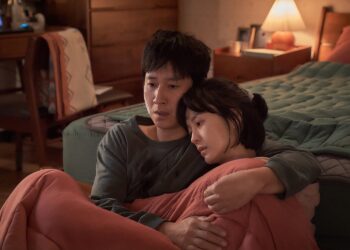
Poetry stars Yoon Jeong-hee in a pitch-perfect performance as Yang Mi-ja, an elderly woman living in the Korean suburbs, who is in sole charge of raising and providing for her teenage grandson Jong-wook (Lee David). Financially, Mi-ja barely gets by on government welfare and her part-time job as Mr. Kang’s (Kim Hee-ra) caretaker. Individually, however, she is as rich as can be: she takes advantage of and appreciates the little joys in life, whether it’s dressing her best on her way to work, literally stopping to smell the roses, or being thoroughly engaged in what her community has to offer during her off-time.
In fact, Mi-ja enrols in a month-long poetry class at her local community centre taught by famous South Korean poet, Kim Yong-taek (playing himself). Unfortunately, her goal of seeing the beauty in the world around her — the main lesson Yong-taek hopes to impart on his students — is jeopardized on multiple fronts. On one hand, there’s Mi-ja’s worsening struggles with her newly diagnosed Alzheimer’s disease. And, on the other, there’s the recent suicide of a teenage girl, who, as it turns out, was repeatedly raped by Jong-wook and his friends.

By her final class, Mi-ja and her fellow students are meant to have written one full poem. This immediately sets up an interesting juxtaposition between her creative process — which involves learning how to, in Yong-taek’s words, “see well” the world around her and thus build emotional connections to it — and her declining state of mind, which is only underscored by the death around her and the degradation of who she thought her grandson to be, of trust in her community, and of the belief in inherent goodness.
Lee’s films are no stranger to examining institutional or individual complexity and failure, as we have seen in Peppermint Candy and Oasis, but Poetry feels all-encompassing — perhaps even suffocating — in the way Mi-ja must seemingly shoulder every burden on her own. She can’t afford to raise her daughter’s son, but she commits herself to it; she wants to do what’s best for Jong-wook even though he lacks the most basic of manners, but wonders if he’s even deserving; she initially has no way of contributing the 30 million won as part of the settlement owed to Agnes’ mother so that she does not press formal charges on her daughter’s rapists, and yet she finds a way — at every turn, we see Mi-ja wrestling with the ugly truths of humanity all while trying to see its beauty for the sake of her art.
Indeed, this film reckons with the mercurial state of being human: every choice we make, good or bad, has consequences that we and those around us must eventually face, which themselves become another stage of good and bad choices that, in turn, also has its own set of consequences — and it’s a cycle that continues forever. In this regard, Poetry’s script is immaculate in how it focuses on Mi-ja’s journey through these choices and consequences, relishing in her constantly-changing feelings and desires, and effectively echoing the ebb and flow of life itself: there are moments where she takes control of her fate in these unpleasant events, but then there are instances where she can’t help but be pushed and pulled by the tides.
Yoon plays Mi-ja with disarming grace and vulnerability, wholly captivating at every turn. Considering the film’s languid pace and runtime of almost two and a half hours, it’s a testament to the actor’s illuminating presence that we stay glued to the screen. For her, the most complicated emotions are somehow communicated with a glance, lifting and breaking your heart with just a look. Even when she makes choices we don’t fully support or understand, we accept it because she so easily communicates just how hard it is to be human, and so we forgive where we can and empathize where we can’t.
It also helps that Lee takes a decidedly naturalistic approach to Poetry. Devoid of a score or soundtrack and featuring shaky cinematography that favours natural lighting, there’s no auteuristic pomp or flare here. This is Mi-ja’s story, and because we are so grounded in her circumstances, she becomes a sort of mirror through which we see ourselves.
Fittingly, Mi-ja’s poem at the end of the film begins with the question: “How is it over there?” Titled “Agnes’ Song,” her poem has, over the years, been interpreted in countless ways — most notably as a conversation between Mi-ja and Agnes — but, now, it feels like a conversation between her and us, and, more importantly, it’s we who are asking the question. After all, she achieved her creative goal (the only one in her class to do so). Despite the mess of the world around her, and its insistence upon showing her only the things that made it ugly, Mi-ja found the beauty and turned it into art. As technology slowly eradicates the need for writers and the process of writing as a human act and art, all we can do is ask her, “How is it over there?”
And yet, Poetry offers hope. Despite its predominant focus on how Mi-ja handles her grandson’s horrific actions and how her dementia is an inevitable doom, there’s something to be said about the film’s title being named after her extra-curricular activity. As if to say: art has stood these last 14 years, and, with the conviction of one woman stopping to look — like, really look — at the trees, there’s a chance it can have 14 more.
‘Poetry’ screens at Metrograph in New York City on April 26 as part of the theatre’s retrospective series, Novel Encounters: the Films of Lee Chang-dong. Check out the official website for more details.