Part disaster movie, part dystopian technothriller, and part teenage coming-of-age story, Neo Sora’s Happyend blends these seemingly disparate genres to form an affecting tale of friendship and love. Set in a near-future Tokyo where earthquakes and fascism constantly rumble in the background, the film focuses on two best friends, mischievous Yuta (Hayato Kurihara) and brooding Kou (Yukito Hidaka) as they approach the end of high school.
The pair lead a close-knit band of music-loving troublemakers, who regularly get into hijinks by sneaking into nightclubs, pranking their school principal, and stealing audio equipment. As the five friends — which also include Ata-chan (Yuta Hayashi), Ming (Shina Peng), and Tomu (Arazi) — anticipate the last days of their time together as carefree students, they find themselves heading towards futures and desires that threaten to split them apart, physically and emotionally.
At the same time, the macropolitics of the country seep into the microcosm of the kids’ high school. After one of their pranks goes a little too far, the teens become subjected to intense technological surveillance as the principal installs high-tech cameras that identify students and flag their misdemeanours. Everything from breaking the dress code to leaving the classroom or smoking is immediately reported. Even more dystopically, everyone can see what’s happening on a huge screen in the building’s courtyard (a natural panopticon for all students and staff). Student reactions to these dystopian, sci-fi intrusions range from immediate acceptance to silly displays of disobedience, culminating with a bold sit-in.


What’s happening within the school echoes the rise of the police state happening outside its walls as the Japanese prime minister seizes more power. According to what plays on background TV screens, the corrupt government has increased police presence under the guise of increasing public safety as earthquakes regularly occur across the country. As a result, citizen protests and marches, with disruptions, vandalism, and police brutality, threaten to spill over into the main story of Happyend.
While the specifics of Japanese politics may be lost in translation for non-Japanese viewers (like this writer), easy parallels can be drawn to other political climates and how some young people are activated by it while some choose ignorance instead. This is, of course, the wedge that comes between Yuta and Kou.
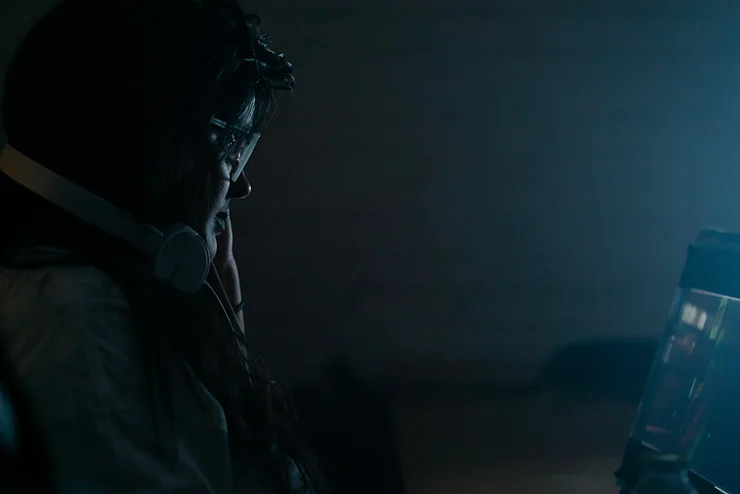
While the two leads initially seem uncannily similar (they’re both tall, attractive, and love techno music, demonstrated by their wearing headphones around their necks on top of their standard school uniforms), their differences quickly start to show. Yuta enjoys hedonism and loves to flirt with danger; as he is usually the first to find new trouble to get into, his friends often find themselves trying to rein in his recklessness. He also lives with a bit more privilege and often hosts parties at his spacious home as his busy single mom is away for work. Yuta’s myopic view of the world has made him emotionally stunted, explaining why his friends keep secrets from him and slowly draw away.
Meanwhile, Kou is more of an observer. He sees the world beyond him, but his eyes are opened further when he meets Fumi (Kilala Inori), an outspoken classmate who regularly participates in political protests. But naturally, his awareness of the system’s unfairness started at birth: Kou is Zainichi Korean, and therefore considered an outsider and second-class citizen by Japanese officials, despite generations of his family having lived in Japan.

Kou is not the only marginalized young person. Tomu, the only Black person in the friendship group, is cast out of class with Kou and other non-Japanese students when a Japanese military official comes to the school to give a talk. His presence in the film proves interesting as Black people don’t often appear in East Asian media, although they, of course, exist in countries like Japan and have for many, many years (I mean, just look up Yasuke, a Black samurai from the 1500s).
Tomu acts as a sort of peacemaker between his friends as the one most acutely aware that their youthful days of fun and frenzy are numbered. Because he will be going to America for college, he wants to enjoy his time with his friends while he still can, returning to the Happyend’s emotional throughline of high school relationships.
Naturally, the film relies heavily on the comfortable rapport between all five friends, especially between Kurihara’s Yuta and Hidaka’s Kou. It achieves this naturalism in spades as the young performers pull off the good humour and tenderness that exists between the teen characters who have known each other all their lives.
The script, too, finds its sweet moments in relationships beyond those that directly involve Yuta and Kou. Ata-chan and Ming, in particular, have a budding romance shown beautifully. In the build up, they share an inside joke where they pretend to read the lips of people having conversations out of earshot, creating a fun and cute moment reflecting their dynamic as a couple.
Despite the literal and metaphorical shake ups in the characters’ final year of school, Happyend does result in something of a happy ending. Yuta and Kou eventually find themselves making inroads toward both change and acceptance. A public act of grace cements their separate futures but also strengthens their friendship, which has existed on a precipice for the entire run time.
The societal challenges don’t go away, and the reality of the future will probably tear them apart again, but for a little bit longer, their halcyon high school days are not a distant memory, yet.