“Wow, thank you for staying up — or getting up early!” Roshan Sethi, director of A Nice Indian Boy, laughs when I told him and Karan Soni, the film’s lead, that it was nearly 4:00 am where I was, about 30 kilometres outside of Manila.
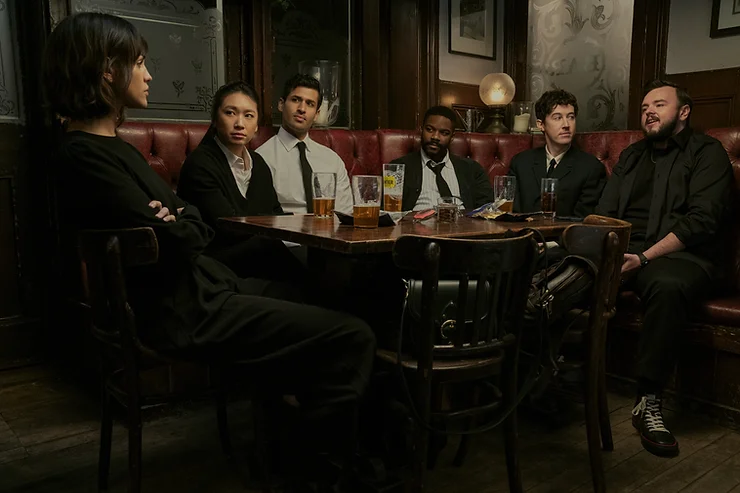
The film, an adaptation of Madhuri Shekar’s stage play, follows Naveen Gavaskar (Soni), a self-effacing gay Indian man who meets and falls for Jay (Jonathan Groff), a charming white man adopted by Indian parents. What unfolds is a tender and sometimes disarmingly funny look at love, family, and identity — told without melodrama or self-seriousness, and steeped in the rituals, rhythms, and minor frictions of everyday life. In our interview, Sethi and Soni talk about adapting the original play, casting Groff, and what it means to make a film that resists reductive labels like “queer rom-com” or “South Indian love story.”
Sethi is especially candid about his frustration with how stories like theirs are often presented: “It annoys me because, for example, Notting Hill is simply a rom-com, whereas our movie is considered a ‘queer South Indian rom-com.’ I feel like we’re subdivided into some crazy Dewey Decimal system, and it implies that a film like Notting Hill is for everyone, while A Nice Indian Boy is just for gay Indians.”
For him, the desire to be seen as just a love story is less about neutrality than equality. “Maybe it’s an overreaction,” Sethi admits. “But our movie is a plain rom-com, the same way Notting Hill isn’t called a ‘librarian rom-com’ or ‘bookstore rom-com.’”
The two spoke openly about the process involved, how the story came together in the edit, and how Soni, ever modest, trusted his collaborators to guide the performance.


“If it’s on the page and you’re honest about it, it’ll translate,” the actor says, crediting editor Stephanie Kaznocha and composer Raashi Kulkarni for helping shape his portrayal of Naveen. Their easy rapport reflects the same tenderness and good humour that defines the film itself.
It probably also helped that Sethi and Soni are real-life partners, making A Nice Indian Boy a sincere love story that hits close to home.

This interview has been edited for brevity and clarity.
The Asian Cut: A Nice Indian Boy started as a play by Madhuri Shekar. What aspects of the original stage version did you feel had to be reinterpreted for film?
Roshan Sethi: The play is obviously so contained because it takes place in just a few locations, and the weddings are not in the play; they are only discussed. Those are the biggest things. Also, we did not adapt the play into a script — that was done by Eric Randall — but we did work on the script and expanded it in other ways.
TAC: There’s a fascinating tension in the film between acknowledgment and acceptance, particularly in how Naveen’s family processes his sexuality. What were the conversations like when shaping this dynamic? Were there moments where you wanted to push this conflict further but pulled back?
RS: No, because we’re describing a different kind of story. This isn’t a coming-out, trenchant, and dark, “Will his parents accept him despite being gay?” story — that would be a different kind of movie. This is a movie that takes place after [Naveen] has come out, when he’s brought home a partner, and his family has accepted him but [are] forced to face the reality of who he is in a way that they haven’t before.
However, it would be inappropriate and not true to the story for them to suddenly devolve into a trenchant conflict about his sexuality. That would be darker fare than what this is and what it wants to be, and that doesn’t come out of any personal desire not to go there. Both [Karan and I] have lived the experience of being gay and Indian, but this is a very specific story that this movie is trying to tell.
TAC: The scene with Naveen’s mother Megha calling him about the movie Milk is hilarious but also deeply telling. Were there any personal experiences or anecdotes that influenced that scene?
RS: Oh, that scene is from [Shekar’s] play. The mother watching Milk and discussing it has been in every version of the play since 2014. That play was written by a woman and not a gay man, out of a desire to understand her parents, and I think that was probably the emotional impetus behind it. The only thing we added is we had Megha recap Milk to her son, because we thought that would be funny. And Karan actually wrote that entire description of Milk, which — Karan, I don’t think you’ve seen. You just read the Wikipedia page, or…?
Karan Soni: I only read the Wikipedia [page], but the character that Zarna [Garg] plays, the mom, is so similar to my mom in real life that I just imagined how my mom would recap it. And that was what came to my mind.
RS: It was so funny! When she says, “[Brolin] is the Thanos!” I thought, “That’s a one-of-a-kind version.”
TAC: That’s exactly the reason I found it funny. Megha narrated it chronologically, as if she were reading off the movie’s official plot synopsis.
KS: Yes! It’s because I just went on Wikipedia and I was like, “Let me see what it says,” and I spent five minutes on that.

TAC: Karan, I would like to know more about your process with Naveen. He has this quiet, self-defeating energy throughout the film — like he’s bracing for the worst at all times. How did you find that balance between making him endearing while still allowing space for his cynicism?
KS: To a certain point, you can’t worry too much about the character being likeable. You have to be honest in the story. I think the secret weapon that I sometimes have is that people inherently find me a little bit likeable, so I can be a little bit ugly. Or sometimes while acting, my face will sell it off enough — but hopefully not to the point where you want to turn the movie off. [laughs] But yeah, I just had to be honest.
The great thing was that despite how the character begins, by the end he’s so joyful, happy, and celebratory. In order to feel that joy, you have to start by seeing where Naveen is at the beginning. Also, I think that people want to see characters change and grow. So you can’t shy away from being honest; otherwise none of it means anything — whether it’s standing up to his parents or dancing at the end of the movie, which is so unlike the version of him at the beginning.
TAC: You mentioned that Naveen undergoes a transformative journey from apprehension to embracing his relationship openly. What aspects of this character arc did you find most challenging to portray?
KS: For me, the beginning parts were the most challenging because as an actor you generally want to show your feelings and emotions while the character isn’t showing any of them. Some of the hardest scenes to film were the initial dates with [Jonathan Groff’s] Jay, because Naveen’s clearly having a good time, but he’s not going to show it. I remember the first few takes I did, Roshan was like, “No, no, no. It’s too much. You can’t be this in love; you have to hide your feelings more.” And I think it was the right direction to go in.
But I feel that back-and-forth — showing that he cares on one hand but also not fully showing it because he’s still so far from that place of caring — was always the most challenging, since you find yourself hoping all of that reads. In fact, every time we watch the movie with an audience and the first date kiss doesn’t happen because of what my character does, there’s usually an audible reaction, and that makes me happy. [laughs] You know the tension is working and the audience wants them to be together, but Naveen himself is the reason it’s not happening.
RS: It always drives me crazy when people are flirting in rom-coms, I don’t know why. Watching people be flirty just makes me cringe.
TAC: Well, it’s convenient for storytelling, for one.
RS: Yeah, and most of us are not confident enough to act that way. I would never talk the way people talk in rom-coms. I wouldn’t even know how.
TAC: And Naveen’s reaction is genuine, especially when you consider that first dates don’t usually pan out the way rom-coms typically show them onscreen.
RS: Yes, because you don’t know each other. You don’t sit down on your first date and just confidently go, “Hi!” I mean, I wouldn’t know how.
KS [to Roshan]: How many first dates are you going on?
RS: That was before! [laughs] It’s always kind of hostile on my side.

TAC: Karan, your chemistry with Jonathan Groff feels effortless, even though your characters are so different — Naveen is skeptical, Jay is all sunshine. Did you and Jonathan do anything specific off-screen to build that dynamic?
KS: Actually, we didn’t have any rehearsal since Jonathan was on another project before we started this movie, so he missed the first days of prep. During the first days of shooting, we did them without him. By the time he landed in Vancouver, where we were filming, we went right into shooting a six-page scene. We had met him once before in New York, a year before we made the movie, and we really got along. He is one of the most likeable people and he’s easy to get along with, but even then it’s never guaranteed that that would translate.
I think we just got really lucky with Jonathan, and it helps with the chemistry when you get along with the person and you like them, because otherwise it would really show on-screen. Roshan and I are such big fans of him, just as a person and of his infectious energy. I’m glad it worked out and that audiences felt there was chemistry between us.
TAC: A Nice Indian Boy juxtaposes traditional Indian family expectations with contemporary LGBTQ+ relationships. How did you navigate this balance to ensure cultural authenticity while promoting progressive themes?
RS: The thing is, I wasn’t thinking outside of this story, because I believe you can’t tell a very good story if you’re preoccupied with any of the implications of the story you’re telling. So unfortunately, you have to keep them outside as much as possible.
Instead, I was mostly interested in whatever felt true. And a lot of it drew on our own personal, lived experiences. It’s hard, because there’s such a desire to avoid stereotypes in cultural representation. Personally, I never cared for that, because I happen to be a walking stereotype: I went to medical school because my mom made me, [and] I have very strict parents. On the other hand, I’m gay, which is not a stereotypical Indian thing to be. I wanted [the film] to feel true more than anything else.
TAC: What reactions from audiences have resonated with you the most, and how do they compare to your initial expectations?
KS: I’ve never been a part of a movie or show where people have opened up so much after they watched it. I think after almost every screening we attended, Roshan and I were crying because someone would unload something about their life to us. And the biggest reactions were often from older people — parents or grandparents — who felt that the movie gently spoke to them in ways that similar movies haven’t before, and that it made them understand their kids or grandkids better as a result. To me, it feels really special because it shows that people are moved by the movie.
RS: At the end of a screening at the Calgary International Film Festival, there was an older man who was standing off to the side, letting other people talk to us but never making an effort to approach. As the evening was winding down, I went up to him because I saw he had been waiting for so long and was so quiet and unobtrusive — I thought he was simply too shy to approach us. When I did, he opened up about how he had recently lost his husband of many years. Pointing at me and Karan, he said, “What you two have is very special, and I just want you guys to know that.” And for someone like me, who’s not a very soft person, that was so sweet!