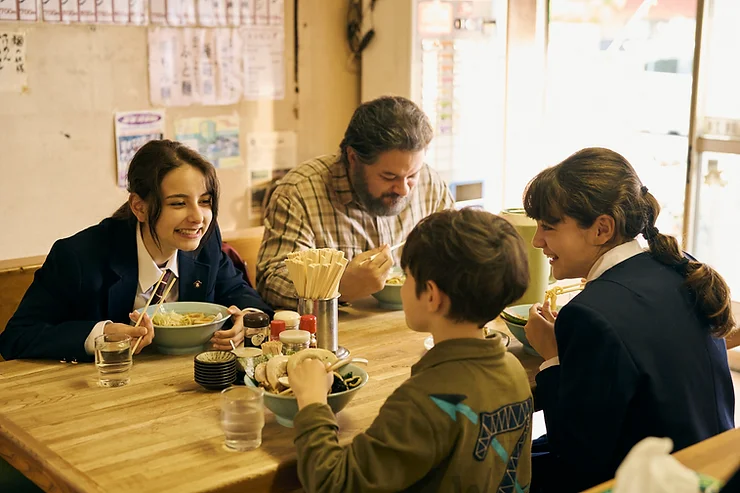
The most striking aspect of Amar Wala’s Shook is the manner in which it explores the cultural identity of the protagonist’s family. The movie follows the life of aspiring writer Ashish (Saamer Usmani), who is trying to cope with his parents’ divorce, as well as the more recent news of his father’s Parkinson’s diagnosis.
The theme of family naturally finds precedence within this plot, but the viewer discovers that the family’s background as immigrants is not overtly forced into the foreground, in the events and subject of their conversations. Instead, the family dynamics are infused with a quiet authenticity, the immigrant identity of this family neither intrusive nor disregarded, but instead infusing the film with a tasteful and uniquely balanced realism.
Shook is, in effect, a coming-of-age tale set in the protagonist’s 20s. Ashish lives a life that is designed to shut him off from himself. Dealing with personal dissatisfaction and self-reproach over his stagnant writing career, he spends his evenings partying with a close group of friends, hurrying to catch the last bus home, and his days idling in front of an empty draft of his next book, with the occasional meeting with publishers sprinkled in between.


Claire (Amy Forsyth) appears as a window into a more cheerful, freer experience of life — a counterpoint to the approach Ashish is taking towards his own. She is presented with a hint of the manic pixie dream girl, full of a contagious joy, but also holding an independent identity — set to move away soon to study geography, and excited to explore horizons beyond Toronto. An anti-meet-cute between the two sets up the frame within which Ashish is forced to confront himself — his misgivings towards his own parents on the one hand, as well as his personal inhibition towards experiencing the joy in life, which he believes is placed on him externally.
There is a soothing infusion of life in the events that take place, the everyday nature of the plot beats, as well as the subtly uncomfortable realities of living in suburban Scarborough, Toronto, so close yet so far from the city. As the elder one among two siblings, Ashish takes it upon himself to show up for his father after his Parkinson’s diagnosis, crossing a certain boundary of awkwardness between the two. It is an endearing display of love as father and son reestablish their bond following the divorce — going on doctor’s visits together, and cooking meals as two clueless men who’ve been fed home-cooked meals all their lives.
At the same time, he finds his secret misgivings and rejection of his new reality quickly unravelling in his outward life. Wala does a brilliant job of keeping the threads simple and close to life. Usmani reminds the Bollywood aficionado of a more soulful and grounded version of Hritik Roshan, carrying an unconscious charm that nevertheless manages to blend into the movie’s everyday settings. While his dramatic range feels strained in the peak moments, he carries a natural soulfulness that blends perfectly with the film’s sober yet soulful tone. On the other hand, Forsyth, in her role as Claire, radiates a genuine exuberance in every scene.
Bernard White as Ashish’s dad, Vijay, brings an adorable humour to the proceedings. A subversion of the typical depiction of the Brown immigrant family seen in Shook is in how both parents are vocally supportive of Ashish’s writing. Vijay, as the more easygoing of the two, brings thoughtful compliments and an openness to new experiences, bringing most of the film’s humour.
The scenes between father and son are by far the most memorable — humour arises almost effortlessly, and the two are able to bond over trivialities, but at the same time, left unable, despite their convivial bond, to reveal their deep fears regarding Vijay’s medical condition. It makes way for some of the movie’s poignant moments, punctuating moments of deep reflection with hilarious punchlines.
As the threads begin to slowly tie up in the second half, one notes the clear intentionality with which every one of them was set up. Certain scenes capture the painful awareness of the passage of time that is captured in universal experiences between parent and child, where the parent suddenly finds themselves negligent like a child, and the child finds themselves castigating their parent for it. There is the sudden realization that this late regression arises out of nothing but fear of the unknown.
Similarly, in a subversion of the typical depiction of Brown family dynamics, we witness a running thread of unconditional love and compassion between the two divorced parents showcased in a few crucial scenes.
Shook brings out its heart for the audience to see without embellishing it with exaggerated sentimentality. The audience is left with cinematographic beauty that feels almost incidental, and a wonderfully integrated cache of soundtracks that recurrently emphasize the beauty in the mundane. What wins the audience over is its unrelenting sincerity.
By the end of the movie’s events, there is no visible change in circumstance, but Ashish has found in himself the capacity to accept his circumstance with cheer, and the meaningful connections that it is brimming with. As he accepts his own hand in the limitations he saw in his life, the core inversion upon which the movie was based makes itself clear: where cultural expectations sometimes arise from the bottom up — as an elder son, and as a son of divorced parents — and where cultural identity is found most clearly in the ways a family emotes and connects with one another.