Daniela Forever by writer-director Nacho Vigalondo draws some obvious comparisons with sci-fi classics like Eternal Sunshine of the Spotless Mind and Inception. Known for a niche variety of cross-genre sci-fi tales, including Colossal starring Anne Hathaway, Vigalondo’s latest work moves deeper into the philosophical, touching upon a flurry of themes.
The film stars Beatrice Grannò of The White Lotus fame as the titular character, and Henry Golding as the story’s protagonist, Nicholas. In spite of a brilliant performance from Golding, the film contains a flatness, especially in the pacing, and an uncertainty in the placement of the secondary themes, that inevitably rob the evocative ending from a sense of finality and completeness.
The movie opens with Nicholas and Daniela’s first meeting at a party in Milan. Both characters are outsiders who moved to the city in pursuit of their passions — one a DJ, and the other an artist. A heartwarming montage quickly lays out their rosy trajectory, but elements of magical realism quickly make themselves apparent. In reality, Nicholas, very unsuccessfully, deals with Daniela’s recent death from a traffic accident.



Devastated by the tragedy and unable to face the reality of loss, he encounters an opportunity to join an experimental therapy program. A mysterious new drug that induces lucid dreams is being tested as a means of overcoming grief and dependency — but the program relies on a series of specific instructions to create the guided lucid dreams with the goal of hastening the process of healing.
Nicholas promptly chucks out the instructions and sets off on an elaborate fantasy adventure, recreating his life with Daniela in his nightly dreams. The concept strongly recalls Michel Gondry’s Eternal Sunshine, and hints at the film’s powerful potential. What follows, though, is a dull and drawn-out sequence in which Nicholas explores the limits of his pill-induced dream lucidity, which lasts almost until the very end.
To the film’s credit, it does a fantastic job of bringing to life the devastating numbness that arises from such an all-encompassing loss. Retaining the rough edges of reality, the movie reveals essential information organically and avoids cinematic exposition. Goulding’s portrayal of grief appears far removed from the romantic, cinema-friendly variety of weepiness, and instead pulls deep with its harrowing quality, as if constantly on the run from a spectre he has no strength to face.
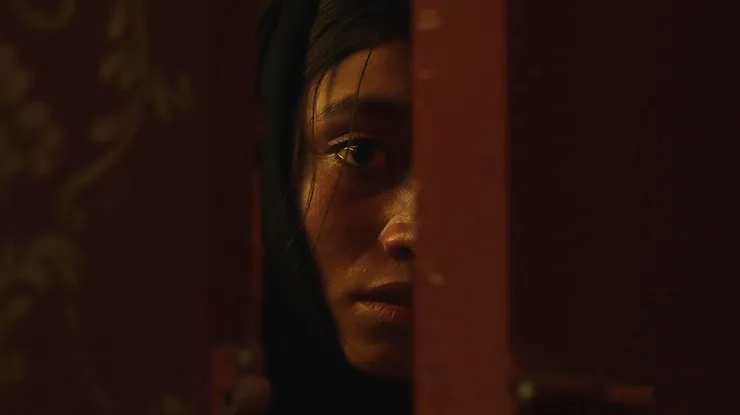
Vigalondo visually segregates dream and reality in a quirky manner where scenes set in real life are presented in a cloistered, squarish aspect ratio with a low-fi quality reminiscent of handycam recordings, while the filmmaker presents the dream sequences with colourful, expansive visuals, shot in a wide aspect ratio. The effect creates scenes set in real life having the opposite feeling of derealization, a sort of troubling distance from the proceedings — an effect that feels artfully intentional in the beginning, but begins to blend into a far more troubling problem with the monotonal tensions and flat pacing.

The latter provides the most vexing aspect of the entire movie as the drawn-out dream explorations of Nicholas are far from uneventful. Numerous observations can be made about how Nicholas approaches Dream Daniela, but a growing problem arises where the dream universe increasingly takes on a life of its own, eventually breaking its own conspicuously displayed rules. At the same time, the extended sequences where Nicholas seeks to recreate some of his most cherished memories with Daniela could have easily been pushed for a greater sentimentality. One wonders about the intention of the filmmaker throughout the bulk of the movie as it drags through its monotone, avoiding obvious opportunities to elicit emotion.
As the strange escapism continues, what continually comes into focus throughout the movie — perhaps, in this sense, a primary theme — is the nature of Nicholas’ character. The manner in which he so casually disregards or completely reformulates the contents of Dream Daniela’s history, memories, and persona continually draws attention and emphasis when he finds over time that his cherished Daniela is growing more and more into an independent persona.
At the same time the movie touches a few times upon the intersection of queerness and misogyny. An oddly humorous moment involves a sex dream where Nicholas conjures a few female companions to accompany himself and Daniela. When Daniela asks for the reverse arrangement, Nicholas grows uncomfortable with the request, but finally acquiesces by dreaming up a doppelganger.
The stagnant pacing takes a rather drastic turn near the end of the movie where Vigalondo releases the entire backlog of all the pent-up emotionality that he saved up throughout the movie, like a limited resource. A harrowing breakdown ensues, showing the true nature of grief and loss as pain intense enough to reject reality.
The ending, ambiguous and evocative, might possibly close up a full circle with the film’s opening. If anything, the ending makes the film worthwhile. The film offers plenty of threads to explore, but none set in with any real conviction; although the closing rumination about the nature of dream and fantasy does stay for a few cherished moments, revealing a precious lesson on healing.