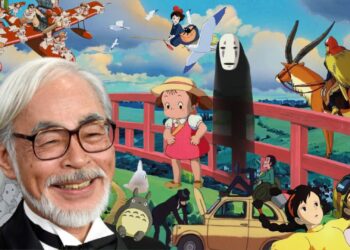
In the enchanted tapestry of cinema, few threads are as distinct and vibrant as Hayao Miyazaki’s brushstrokes. And right out of the gates, Spirited Away grabs your attention and doesn’t let go. Miyazaki’s attention to detail is nothing short of breathtaking, embodying Studio Ghibli’s prowess in bringing fantastical worlds to life.
Spirited Away tells the story of 10-year-old Chihiro, who’s travelling with her parents to their new home. A typical child, Chihiro harbours resentment toward her parents for moving, leaving her friends behind without the chance for Chihiro to say goodbye. Midway through their journey, they stumble upon a seemingly abandoned amusement park.
As they explore the surroundings, Chihiro’s parents accidentally undergo a bizarre transformation, leaving their daughter alone to rescue her parents and find their way back. The film sees Chihiro navigate the enchanting but dangerous realm ruled by spirits, witches, and fantastical creatures. Along the way, she encounters strange characters and uncovers the mysteries of the spirit world.
As a journey of self-discovery, Spirited Away gradually unfolds into a poignant and magical adventure that rises above the boundaries of ordinary animation. Whether capturing the whimsy of a magical encounter or the tender moments of Chihiro’s development, the film also benefits from the rich film score courtesy of regular Miyazaki collaborator, Joe Hisaishi. The result is a symphony of emotion and wonder that mesmerises the audiences and elevates the film to new heights.
As the weaver of the aforementioned animated tapestries, Miyazaki etches his signature into every frame. His influences, ranging from traditional Japanese folklore to the works of Western literary giants, are palpable here. And yet, for all his genius, the magic happens when this unholy marriage results in a narrative mosaic that is uniquely his own.


Upon closer look, Spirited Away showcases Miyazaki’s influences in full display, including his penchant for drawing from his own experiences and childhood memories. And while childhood innocence and self-discovery are recurring themes in his films, Miyazaki also draws inspiration from European literature. In particular, he was fascinated with the works of British author Diana Wynne Jones, specifically her novel Howl’s Moving Castle, which had an impact on the filmmaker’s creative process. It wasn’t surprising at all that Miyazaki later on decided to adapt the novel into a film.

And then, there’s the homage to Japanese folklore and mythology. Spirited Away boasts a plethora of Miyazaki’s trademark symbolism. For instance, the yōkai lore serves as inspiration to several characters, including River Spirit, soot sprites, and No-Face. The filmmaker’s imaginative reinterpretation of these creatures adds a layer of cultural richness to the film.
The film is also deeply rooted in Shinto beliefs and Japanese spirituality. The bathhouse, for example, serves as a liminal space where the ordinary and the supernatural coexist. This coexistence, so beautifully captured in the film, is a common theme in Shintoism.
Interestingly, Miyazaki somehow zeroes in on the bathhouse and the many ways it symbolises several aspects of Japanese tradition and culture. For one, it depicts a microcosm that reflects the collective experience where individuals from different backgrounds come together. As Spirited Away shows the hierarchy and rules within the bathhouse, such arrangements parallel aspects of traditional Japanese workplace culture today, highlighting Miyazaki’s social commentary.
Probably the most important theme I appreciated in the film concerns its commentary on environmentalism. Miyazaki emphasizes the effects of pollution and environmental degradation, as portrayed by the polluted River Spirit. This reflects the filmmaker’s own concerns about the dangers industrialization poses to the environment when left unchecked. These might explain why I’ve always looked at Spirited Away as partly a horror film. And even after subsequent re-watches, its effect still holds up.
Is Spirited Away perfect? Perhaps not in everyone’s eyes. Miyazaki’s predilection for mawkishness has always been a point of contention, and those concerns are valid. Some detractors might even find his storytelling elliptical, and his narratives can tend to meander, even if most of them usually come to the same conclusions. Case in point: without spoiling anything, the film ends on a typical bittersweet note. Apart from Chihiro and Haku poignantly bidding each other farewell, the former’s self-discovery transforms the way she sees the world and herself.
That said, those are minor quibbles in the grand scheme of things. To dissect Miyazaki’s work with surgical precision is to miss the point entirely. There’s a beauty in the ambiguity of his narratives, a deliberate choice that invites interpretation and introspection.
But more importantly, Miyazaki’s films are not just stories; they are experiences, immersive journeys made by a director who understands the alchemy of powerful storytelling. His influences are evident in the tapestry he weaves and—truth be told—the results are nothing short of spellbinding.
20-something years since its release, Spirited Away remains an enticing invitation to go along for the ride. After all, how often do films manage to captivate both children and adults alike? For what it’s worth, it’s a testament to a passionate filmmaker whose voice transcends the medium, elevating animation to the realm of art.
It’s also, in this critic’s opinion, Hayao Miyazaki’s undeniable masterpiece.