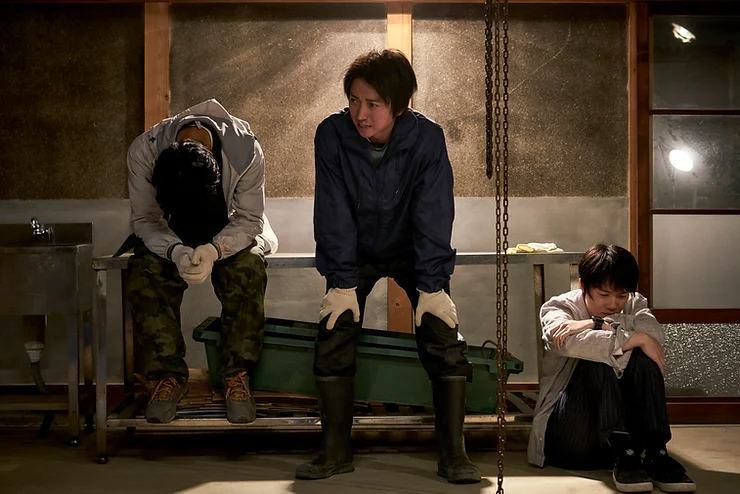
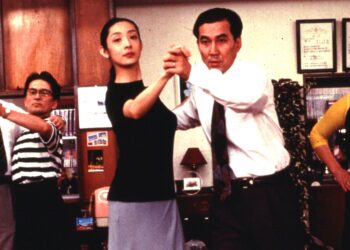
The sort of surrealism displayed by films like The Red Spectacles often test the viewer’s own grounding in their point of view as they engage with the story. Upon succeeding in the challenge, the viewer may discover a hidden freedom to extricate oneself from the habitual tendency to watch a movie from within constrained structures of meaning and explore much greater breadths of experience. And in that freedom, a deeper grasp on a more compelling essence can be found, more so than in any work that seeks to draw meanings with an exactness.
This could very well be the strange appeal of The Red Spectacles, which has retained a close cult following over the years since its initial release in 1987. Filmmaker Mamoru Oshii certainly belongs to that category of filmmakers who revel in ambiguities drawn up from unfathomable depths, and his more prominent works such as Ghost in the Shell, carry this DNA prominently. It remains an illuminating experience that speaks to the undiluted essence of Oshii’s maverick creative compass — one that’s as much an exploration into the act of filmmaking as it is about the specific themes of the film itself.
The Red Spectacles acts as the closing remarks of an entire saga with its own elaborate fictional universe as a sci-fi tale involving a dystopian, authoritarian government, a brutal police force, and much political intrigue. It’s the final droplet that is wrung out from a drying cloth, and captures many of the through-lines that define the Kerberos Saga. This dense narrative complexity creates the right platform for much of the abstractions that arise within the film, giving the philosophical meanderings something to cling to.



The film begins with the last stand of three members of the “Kerberos” unit — a particularly gruesome police force created for the specific goal of eradicating crime in the country with any force necessary. The Kerberos unit has already been disbanded before the events of the film; the three runaways are in the midst of a final ploy to escape the country with their special-powered armours. But only one makes it out — Kōichi Todome (Shigeru Chiba), who leaves with a promise to return for his teammates.
Three years later, Kōichi secretly returns to Tokyo to carry out his promise. Oshii marks the time jump by shift to black-and-white, and the movie carries on in this manner until the ending, where the colour gradually returns harbouring much significance. Kōichi finds Tokyo drastically different from how he left it; almost a ghost city. The movie follows his strange, surreal adventure through the night as he searches for his old Kerberos members, surviving encounters with the Special Force detective, Bunmei (Tessho Genda), who is tasked with hunting down runaway Kerberos members.
The Red Spectacles essentially offers up a fever dream that Kōichi experiences shortly after arriving in Tokyo. The greyscale becomes the perfect tool for Oshii’s vision — tall, dark shadows pervade the city’s beguiling architecture, pursuing Kōichi at every turn. The labyrinthine buildings feel at once realistic yet parsed within a strange irrationality. It feels significant that his first few encounters with these buildings involve Kōichi traversing a series of stairs and elevators that seem to only go down. All the while, posters featuring the same image of an unknown woman follow him along — this recurrence carries on throughout the movie, but is never once addressed.

Kōichi’s human encounters begin not long after a group of assassins ambush him as he settles into a shady hotel. In a bizarre manner, a door opens filled from top to bottom with faces caked in white paint, beholding sadistic grins. Killer mimes dressed in slacks and tank tops that signal no reckoning of practicality.
The film contains a strange insert of slapstick comedy, beginning with the fight scenes where some shots replicate anime more than real-life physical comedy. Set at the tail end of an intense, Judge Dredd-type storyline, The Red Spectacles renders like a meditative pitch thrust inside an action cinematic universe — think Logan without the fighting. Oshii being the filmmaker he is, doesn’t settle for a one-dimensional rumination; he is keen to disorient and puts the narrative through paces, such as out-of-place slapstick comedy.
The film draws a recurring symbolic parallel between the Kerberos, referred to by imagery of dogs, and the new government order, symbolized through overflowing placements of cat imagery — after all, Kōichi is in the enemy’s den. The dystopian rules of the government are demonstrated via an unusual example: the government has outlawed late-night food stalls, believing them to be harbingers of dissent. In response, numerous underground noodle shops have opened, which are displayed prominently in the film.
Through his nightly adventure, Kōichi manages to track down a few of his old teammates, but his search keeps getting set back as he gets poisoned multiple times by laxatives. The film takes quite an irreverent tone in this way — as if offering a weird cushion against outright violence or a direct experience of the stifling environment — the defining quality of life under the authoritarian government.
Oshii frequently punctuates scenes with dense, philosophical dialogue that hold very little relation to the story at hand. Borrowing from literary classics like Shakespeare and Pushkin, Oshii gives this portion of the script undue tonal weight, often played off as pointless gags, just there for the texture.
Yet gradually the ruminative quality that reverberates throughout all of these bizarre, discordant flurries of events begin to take hold upon the viewer. The most serious beating that Kōichi receives is an instance of psychological torture where Bunmei sits him down and reveals the emotional turmoil that his teammates went through in waiting for him.

The great void beyond established structures of meaning is a space that also holds the greatest evocative potential. The Red Spectacles may be considered too long or imperfectly paced; but then again, no actual pacing rules exist in a sequence of fantasy.
A semblance of order gradually arises through the extended interactions that Kōichi finds himself entrenched in the longer he stays in the city. The most heart-breaking one being his conversation with Midori (Machiko Washio), one of the two teammates Kōichi left behind when he escaped three years earlier. Having done whatever was needed of her to survive after the dissolution of the Kerberos unit, she lost all her self-respect and her meandering thoughts vacillating between the helpless fate, which involves her being born as a woman, as well as her choices to let go of her ideals in order to continue surviving, to let go of hope, and to live with the sense of being a traitor to her own ideals.
Yet, considering that all these events take place within Kōichi’s dream, these interactions, too, reveal his own sentiments about his actions: his guilt, the people and things he most cherished, and his inability to forgive himself — all set in the context of the political context of his actions.
The 4K restoration of The Red Spectacles certainly adds to the storytelling of the film. The black-and-white visuals tends to strip movies of everything superfluous, leaving only that which is experience. In the press statement attached to the 4K release, Oshii specially highlights the significance of the red colour in the film. The technical workaround that allowed the movie to transition back to colour in the final scene, highlighting the vivid red in the shot with the “phantom red girl,” creates a unique visual effect that could only be experienced in original print — until now.
The Red Spectacle creates a richer experience with subsequent viewings, and the 4K version adds a new dimension to that experience.