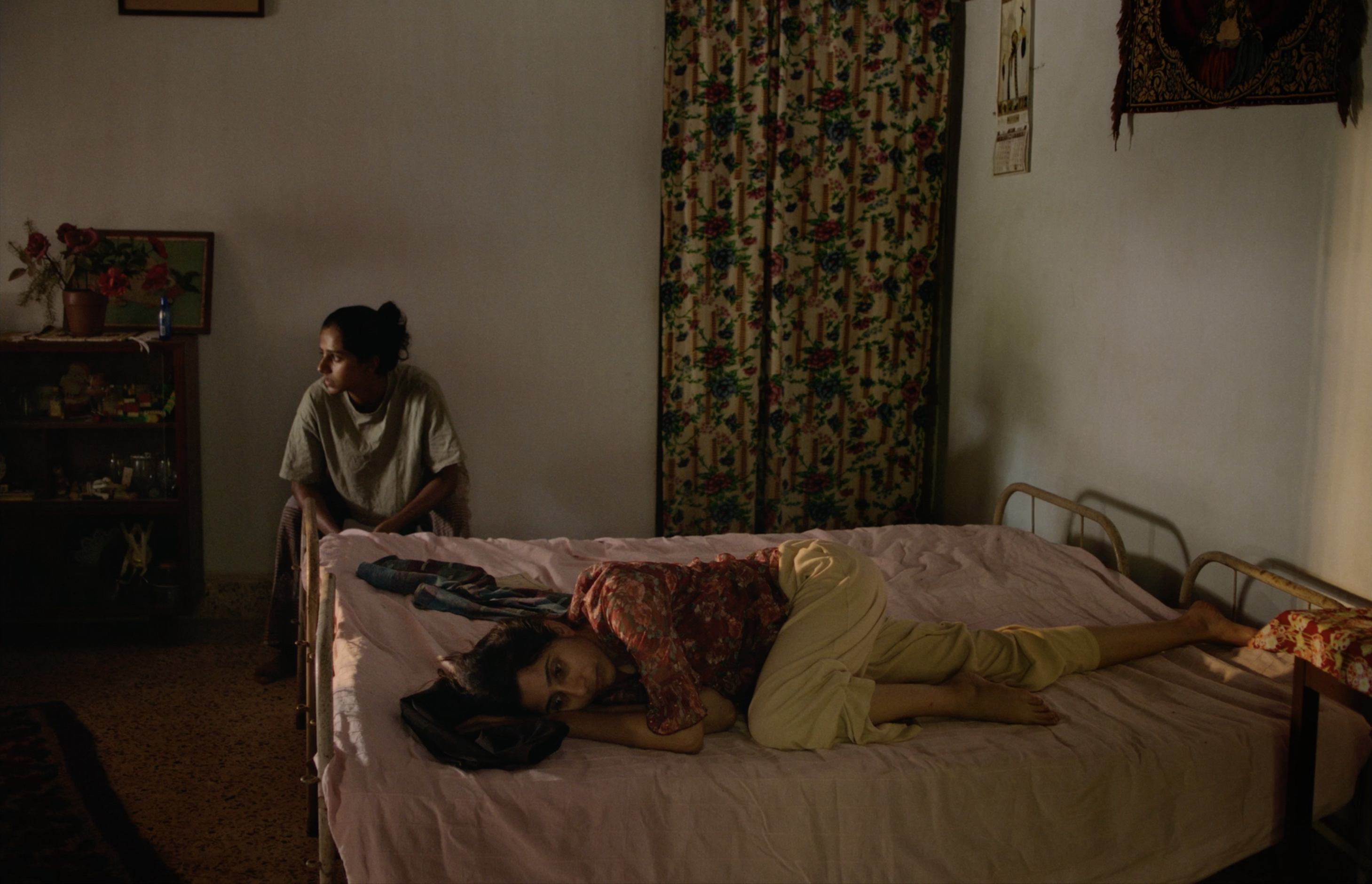
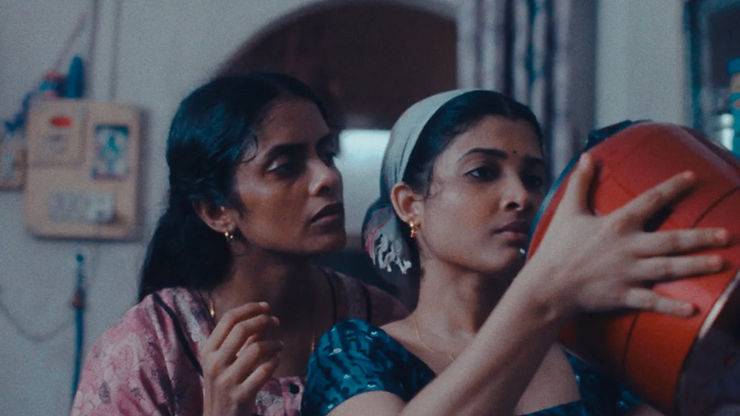
A decade before her smash hit Bend It Like Beckham, British-Indian director Gurinder Chadha made her feature directorial debut with a different film in 1993, one also containing four words and two alliterated B’s: Bhaji on the Beach.
Bhaji follows an ensemble of Indian women on a day trip to the seaside. Some of them are older and born in India, and the rest are younger and born in England. The trip is sponsored by a local South Asian women’s shelter run by Simi (Shaheen Khan), instantly recognisable as Jess’ mother from Bend It. Here, she wears a leather jacket and tries to get this motley group of women to be nice to each other — a task so stressful it makes her take up smoking.
The presence of Ginder (Kim Vithana) unsettles the older women. A young mother living in the shelter, Ginder has just filed for her divorce from Ranjit (Jimmi Harkishin), a member of a beloved family in the community. Her decision “to get the English courts involved” has caused the elders, including her own parents, to shun her — and not quietly. Throughout the trip, the aunties lament how the West has corrupted their daughters (never their sons). The young women just roll their eyes in response; they’re used to it.


Other day trippers include medical school–bound golden child Hashida (Sarita Khajuria), whose true passion is art. She has just discovered she is pregnant by Oliver (Mo Sesay), her Jamaican-British boyfriend. A soft-spoken aunty Asha (Lalita Ahmed) has also chosen to take in the sights, though her daydreams — more like day-nightmares — plague her. In them, God shouts “Duty! Honor! Sacrifice!” at her as she runs away. The wealthy, modern, and flirtatious Rekha (Souad Faress), fresh off the boat from Bombay, serves as a foil to Asha and two other aunties. Rekha’s attitude aligns more with mischievous teenage sisters Ladhu and Madhu (Nisha Nayar and Renu Kochar), who joined the trip with the sole purpose of having a good time.
It’s easy to write Bhaji off as an “issues movie.” It covers xenophobia and racism (by White people against Indians, and Indians against Black people), domestic abuse and abortion. It is an unabashedly feminist work of art. And yet the movie never feels weighed down by its tackling of various -isms, in large part due to its perfectly paced screenplay. Penned by British comedy legend Meera Syal, the script contains zinger after zinger (“You’re about as fun as a fart in a sari”), and embraces slapstick. A truly epic scene in the film sees the most formidable Pushpa aunty (Zohra Seghal) roped into a Magic Mike–style striptease.
These lighter moments make the serious ones more potent. The aforementioned striptease, for example, ends abruptly when a stripper removes Ginder’s jacket to reveal bruises up and down her arms. Until that point, the film doesn’t make it 100% certain whether the handsome Ranjit — with his big, soft eyes — is capable of battery.
Yes, he has enlisted the help of his two brothers to track Ginder down and bully her into staying in the marriage. But his parents ask him to do so, and what’s a good son to do, right? Plus, he’s nowhere near as bad as his brother Balbir (Tanveer Ghani), the kind of guy who shoves Ginder’s uncle’s face into samosa filling, asphyxiating him until he reveals her whereabouts. Ginder herself blames Ranjit’s family when she considers going back to him. Maybe if we took more day trips together, she tells a disapproving Simi, things would be better. So when the striptease reveals Ginder’s bruises, the audience is as shocked as the aunties.
Chadha’s choice to film in Blackpool — a sort of British Atlantic City, more gaudy than glamorous — is no coincidence. (The town is most famous for being the filming location of the TV franchise Strictly Come Dancing, known everywhere else in the world as Dancing with the Stars.) Through Chadha’s camera, 1990s Blackpool becomes a place where costumed men — treading dangerously close to brownface — run booths where people can race toy camels, pose for photos with a giant snake around their shoulders, and buy keychains with their name on it. (There is no option for Ginder’s son Amrik, of course.)
Despite all this, Blackpool appears so extra, it’s charming, and one can’t help but let their guard down. “When the Illuminations are on, [it] is where England meets India,” Chadha told Sight and Sound in 1994. By setting Bhaji in a funhouse mirror of Bombay (as it was then known), her characters can show their true colours.
This is especially true of demure aunty Asha, whose circus-like daydreams become so intense that, in one instance, she finds herself thigh-deep in the ocean, with no idea how she got there. Local eccentric Ambrose Waddington (Peter Cellier) rescues Asha and subsequently takes a keen and somewhat creepy interest in her. On the hush-hush tryst that follows, Ambrose laments how Blackpuddlians no longer go to the opera, in contrast to the way Indians like Asha have “held on to their traditions.”
Ambrose’s over-romanticisation of Indian culture compels Asha to finally stand up to the great, punishing God in her head. She finally lets herself feel the rage of having to give up singing, which she studied in college, at her husband’s behest. As their van drives out of Blackpool, she sees Ambrose try to romance two Arab tourists, amused and endeared, but also relieved to head home, back to the familiar.
The souring of Ginder and Ranjit’s love story contrasts with that of Hashida and Oliver. At the beginning of the movie, when Hashida tells him she’s pregnant, it quickly devolves into an argument where Oliver gets upset about how he’s been kept a secret from her family. (Hashida, however, is close enough with Oliver’s father to send a birthday card.) In a romantic gesture, Oliver drives his motorcycle all the way to Blackpool, and knows exactly where to find her: at the art museum. The film portrays their relationship as tender and loving, an antidote to the anti-Black racism perpetuated by the older Indian aunties.
Ultimately, Bhaji on the Beach offers a joyful film — it celebrates the multiculturalism of Britain, flaws and all. Producers might hesitate to make a film like Bhaji today, worrying that audiences won’t be able to look past the light brushstrokes with which Chadha and Syal paint racism. (In fairness, the 1990s were a more optimistic time.) But that is exactly what makes Bhaji so powerful.
By portraying racism as more of an annoyance than a tragedy, the movie gives its characters (and audience) permission to let loose and have fun, away from a patriarchal surveillance state that masquerades as “community” and “culture.” It is, after all, their day off.