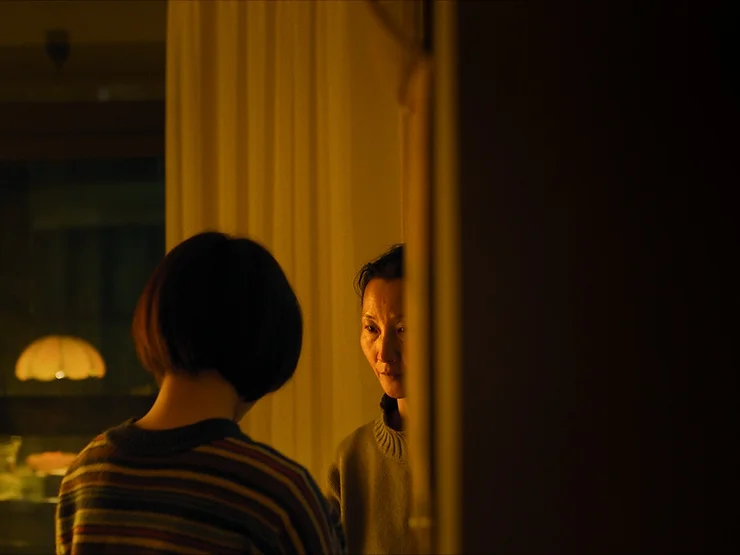
Very few Tibetan-language films are shown internationally, making it very exciting to see one by a Tibetan-Canadian director screening at the Toronto International Film Festival this year! 100 Sunset follows Kunsel (Tenzin Kunsel), an aloof kleptomaniac living in an insular group of Tibetan expats — a community that seems to exist solely within a Toronto apartment complex located at the titular address.
The arrival of a new couple in one of the buildings shakes things up for the withdrawn protagonist, who is immediately attracted to the bold and pretty Passang (Sonam Choekyi). The two young women become fast friends, bonded by shared mischievousness. They spend their days exploring the city and its surroundings together, but their modern desires soon clash with the tradition that surrounds them.
Director Kunsang Kyirong displays a rich tapestry of rituals and gatherings in the film’s background, providing an intriguing glimpse into the Tibetan community of Toronto. Among the customs seen are traditional foods, religious habits, ceremonial items, traditional garments, and community celebrations. Of course, the Dalai Lama’s likeness also makes an appearance.


Switching back and forth between a roving, voyeuristic, and intimate handheld camera (which the main character lifts early on in the film) and a static, distanced, and cool non-diegetic lens, 100 Sunset has a strange, disjointed visual style that echoes the dual impulses at play in the story. On one hand, the camcorder’s throwback-aesthetic has a messy immediacy that complements the main characters’ youthfulness. (Its usage also brings to mind the iconic apartment voyeurism of Rear Window and the elusiveness of memory in Aftersun.)
On the other hand, the detached and still camera routinely draws the viewers’ attention to an element of nature or some other large, immovable feature — like a tree-topped peak, clouds slipping between buildings, or an empty public pool. In fact, it readily chooses not to focus on the characters, allowing them to slip partway out of frame, with just their mouths visible, as if to imply that these human activities will pass but nature will be here forever.
100 Sunset proves Kyirong to be a fascinating filmmaker, unafraid to experiment with artful camerawork, subtle storytelling, and a zen-like pace. Viewers are sure to want to understand more of the lesser-seen-onscreen Tibetan community and customs as a result of watching this film — and why some people like Kunsel and Passang want to leave it.