The Glassworker is defined first and foremost by the ceilings it shattered on its way to being made as the first hand-drawn animated feature produced entirely in Pakistan. Its home country recognized this achievement by submitting the movie as Pakistan’s official submission to the 97th Academy Awards.
But the badge of pathbearer can sometimes prove to be a burden for a work of art, as its genuine experience gets locked up behind the tag of pioneership. Those, at least, were the thoughts I was toying with as I dove into my viewing of The Glassworker, ahead of its North American release via Watermelon Pictures.
I was pleased to find myself overwhelmed with a purity that I hadn’t experienced since the time I stumbled upon the magic known as Spirited Away, my first encounter with Hayao Miyazaki.

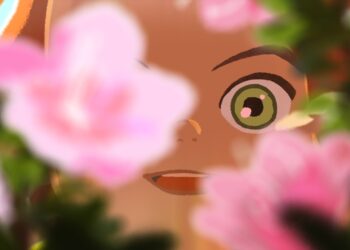
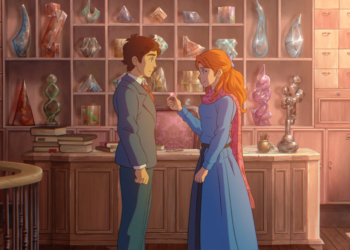
The Glassworker, Usman Riaz’s feature directorial debut, follows a childhood romance between the son of a glassworker, Vincent (voiced by Mooroo in Urdu, and Sacha Dhawan in English), and Alliz (Mariam Riaz Paracha in Urdu, and Anjli Mohindra in English), the daughter of a colonel, under the looming threat of a war that threatens to land on their placid, seaside town. Within a scene or two of the beginning of the film, all the narrow boxes of expectations I had inadvertently built up in my head were quickly swept away by the flood of warm, life-affirming vitality that The Glassworker floods every scene.
Truth be told, The Glassworker almost feels like an overt homage to the great Japanese auteur. Riaz, also the movie’s co-writer, co-composer, and one of the animators, professes a deep love for Miyazaki and found his way to art and animation through his works. But in adopting a Miyazaki-coded animation style to forge a path for the future of animation in Pakistan, he also demonstrates the very heart of what made Miyazaki’s films click: Mu, the emptiness that breathes true life into a work of art.


The creative grind that goes behind mastering this elusive heart was what I was most fascinated with as I spoke with Riaz over a video call, exploring his decade-long journey into making The Glassworker.
His devotion towards Miyazaki and the American classics became obvious. “The quality of the lines in a Ghibli film just move me so much,” he shares. “The way they draw form, the folds in a clothing, or even the old Walt Disney cartoons, Pinocchio, Bambi, Snow White, just done with so much integrity. I wanted to capture that feeling with this film.”
Coming from a family with a strong artistic background — his family members have been famed dancers, poets, and actors — Riaz received a fertile creative environment in which to foster his talents. He picked up the pencil at a young age, as well as music (which he continues as a separate career). The animated film medium represents a natural amalgamation of all these creative passions — in his words, “the culmination of all the things that I love coming together into a singular product.”

Listening to Riaz narrate the story of how The Glassworker came about, it almost feels fated, or at least an inevitable path for him as he followed through his creative interests with absolute conviction. For much of his creative life, Riaz was less interested in being bound up by some creative label and more in the freedom of creative exploration. A handful of stints into directing short films, he still hadn’t really decided that he wanted to be a director, let alone a pathbreaking one.
But it was the deep passion that he fostered for the animated medium that inevitably pulled him towards animated storytelling. Yet, even as he set about working on drawings and storyboards for The Glassworker, he remained unsure about whether it was actually possible to make the film as an animated feature.
“I just didn’t think it was ever possible,” he explains. “I toyed with the idea of doing it in live action, but then all these set pieces, all this fantastical environment, all of that, how will we do that in live action?”
Eventually, it was his wife, Maryam (associate director and art director for The Glassworker), who gave him the final nudge he needed to decide upon the animated medium.
The decision became a turning point in Riaz’s life, creatively and otherwise — almost like the beginning of his own hero’s journey. For starters, Pakistan didn’t have the infrastructure or expertise required to produce a hand-drawn animated film. And while Riaz had the theoretical understanding of the technicalities, he would need to figure out the practical applications through trial and error. To do this, he established Mano Animation Studios, brought together a homegrown team of animators, and set out on what would prove to be just as much a journey of personal growth as a creative one.
The challenges were not just creative in nature, but also about holding true to Riaz’s vision, and carrying forward despite personal fears and heated derision from naysayers.
“I was very scared in a lot of those moments, either while we were getting the funding, or when we were figuring out how to build the team, or just moments where it felt like it would all come crashing down,” he recalls. But, hand-in-hand, he also demonstrated a deep clarity and insight about the battles with inner turmoil that allowed him to keep moving — something that seemed to arise in large part from an immense capacity for feeling.

“I kept telling myself that, you know, it’s good to be afraid because it shows you care,” says the filmmaker. “You want to keep moving forward and overcoming that fear. That is courage. If I wasn’t afraid, if I wasn’t anxious, then how will I get the opportunity to show how much I care about this craft?”
These words hold the essence of Riaz’s guiding ethos — the gentle touch, the life-affirming self-compassion that permeates every frame of The Glassworker: Courage is when you overcome your fears. If I was completely stoic, then there was no journey for me to go through and challenges to overcome. Keep your heart open — something I have to constantly keep reminding myself.
Diaz showcases a similar clarity of approach in how he was able to set aside the mass of denigrating words lobbed in his direction. “You can either get angry at them and resent the world, or you can say, ‘No, they haven’t had the experiences that I’ve had. They don’t see what I see. And it’s okay for them to say that. I will keep moving forward and I will not resent anyone.’”
Through this battle, he found personal wisdom to grow as a human, having been especially motivated by his anger and desire to prove detractors wrong in the early years.
But, most visibly, it was his deep love and passion for the craft that gave him much of the drive to persevere through the decade-long process of turning the vision for The Glassworker into a reality.
The Glassworker presents as a work brimming with life, and offers pearls of insights about navigating the world’s thorns, its complex relationships, and the tender strength needed to hold true to one’s childhood innocence. The sense of the gestalt present in every single scene of the movie seems to mirror Riaz’s own personal process and journey of creating the film, where all artistic endeavours are united in essence and where a creative project can naturally be an extension of the inner work one goes through to gain life’s wisdoms.

Riaz elaborates upon some of the same unity of essence within his own creative processes. “I think because I’m a musician as well, and a composer, when I look at Hayao Miyazaki’s storyboards, I don’t see drawings,” he explains.
He continues, “I see a musical score, an orchestrated score, because he thinks of everything. You can look at it on a piece of paper, you can read it from left to right, but you can also read it vertically. And Hayao Miyazaki’s storyboards are like that, where yes, the story is flowing, but there’s so many other strands that he’s branching off into, or then reconnecting later.”
In seeking to retain the same sense of flow in The Glassworker, the importance of a good story became apparent to him. Drawing all the storyboards by himself, he also focused on refining the story and working on it continually to make it as strong as possible, while the film was unfolding.
Wrestling against the constant uncertainty about the finish line, Riaz remembers the moment when he finished all the storyboards and “held them in my hand, 500 pages of all the drawings,” as his most memorable moment throughout the entire journey.
His narration of that moment, once again, brings to mind the united creative field in which he operates: “I said I’ve done something that I would only dream about, because my hero is and always will be Hayao Miyazaki. I have all his storyboard books. I get emotional talking about this, but I had all of them. So when I had mine in my hands, I was like, ‘I’ve lived in them.’”
For Riaz, the state of being with which he approached all the technical details that went into the making of The Glassworker was no different from the passion and awe with which he poured over the works of his idols.
Following such an involving, painstaking process, The Glassworker has now been released in North America where a much broader audience base will gain the chance to experience it in theatres. This brings us back to the original question: How does Riaz want the film to be perceived by viewers?
Quite simply: “To take you to another world. A world that doesn’t exist in our reality.”