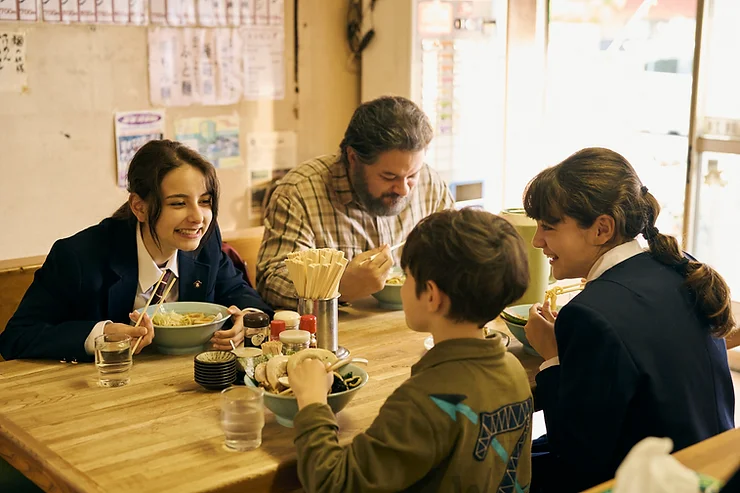
Cathy Garcia-Sampana is warm in a way that catches you off guard. Before I even settle into my seat, she laughs and says, “Nakakatakot ka naman pala, Paul!” upon learning I’m a film critic. “Baka i-critique mo yung interview natin ha!” (“You’re actually scary, Paul! You might critique this interview too!”) It’s a joke, but it breaks whatever tension normally sits at the start of conversations like this.
What follows is quieter. We’re seated in a small conference room at Star Cinema’s headquarters in Quezon City on a fair Saturday afternoon, and Garcia-Sampana remains easy and light as we talk. She expresses an appreciation for platforms and publications that take Filipino cinema seriously enough to discuss it, not just in the Philippines but also internationally. At one point, she gestures to the poster for Meet, Greet & Bye, her latest film, displayed behind us. It’s an image of a family portrait with a small crease splitting Piolo Pascual’s character from the rest of the group — an almost imperceptible detail, except that people have noticed.
“You know what’s funny?” she asks. “That crease has generated so many theories.” I tell her that even within my own circle of critics, we’ve been debating its meaning. She just smiles, the kind that suggests both amusement and intent.
“That’s the goal.”
Garcia-Sampana is one of the most accomplished directors in contemporary Filipino cinema. Her filmography — from One More Chance to Four Sisters and a Wedding to Hello, Love, Goodbye — has shaped not only audience sensibilities, but emotional memory. With Meet, Greet & Bye, she turns toward something more intimate and more painful, exploring a story rooted in family, absence, and a kind of love that hurts as much as it heals.



This interview has been edited for brevity and clarity.
The Asian Cut: You’ve directed some of the most iconic Filipino films — One More Chance to Hello, Love, Goodbye. How would you describe the evolution of your creative perspective over the years?
Cathy Garcia-Sampana: I majored in Film and Audiovisual Communication at the University of the Philippines. You can just imagine what was in my head when I graduated — all that was in the books were Hollywood films. Naturally, my introduction to the arts was through those films. Unfortunately, my heart wasn’t there. When I finally stepped into Philippine cinema, I fell in love with it, and in the process I immediately found myself there.
I’ll be the first to admit that I’m not a brainy, artsy-fartsy type. I was just a normal student who loved watching films and reading Filipino comic serials. I bring these up because even I was surprised with myself: I’m a pretty simple thinker, and an even simpler storyteller. I never wanted to become a director to begin with! [laughs] But I came to the realization of, “Hey, I can actually tell a story.”
As far as evolution of how I tell stories, though, it mostly stayed the same. I held onto the things I learned from my mentor, the late Marilou Diaz-Abaya, that success is measured by the number of hearts you touch. That has been my guiding principle from then until now. So whenever I make a new film, I always see to it that I touch the hearts of as many people as I can, as if reassuring them, “Hey, life is still worth it.”
TAC: Speaking of making films to touch the audiences’ hearts, I want to talk about Meet, Greet & Bye. What was the initial spark for this story? Was there a personal experience or emotional moment that made you feel you had to tell this one?
CGS: This project was challenging for us because, personally, I really don’t enjoy directing family dramas. Even Star Cinema knows that. It actually took a lot before I finally said yes to the first one I did — Four Sisters and a Wedding back in 2013. And even then, the compromise was that I would direct it, but not treat it as a straight drama.
For me, family dramas hit so close to home. I always feel like, if the audience already knows this pain in real life, why would I show it to them again on screen? How do I tell a story that they’re already familiar with? And on top of that, I’ve always believed that the moviegoing experience shouldn’t unintentionally add to someone’s pain. We all go to the cinema hoping to feel something, but not to leave with a heavier heart than the one we came in with.
After directing Four Sisters and a Wedding under that condition, I eventually found myself taking on more family-centered films like Seven Sundays and Three Words to Forever. So when the studio came to me with Meet, Greet & Bye, my first reaction was really, “What now? How do we tell another family story, one that already feels so familiar to Filipino households?”
I had to ask the studio heads and even my own team: Why this story? Why tell it now? And through those conversations, I realized something: I wanted this film to be my love letter to my children. And the young actors in the cast — they felt the same in their own way. They wanted it to be their love letter to their parents.

TAC: I find it fascinating that you say you’re not a fan of family dramas, and yet your films have captured everyday Filipino family dynamics so powerfully. With Meet, Greet & Bye, in what ways does it feel similar to your past work, and in what ways does it feel completely different?
CGS: For me, this is the most grounded. But at the same time…it’s also the most painful film I’ve made so far. The subject itself — a matriarch battling cancer — is very delicate. All of us know someone who has gone through the Big C. I went through it with my mother. So it’s something I understand, personally.
Because of that, I knew the film had to stay real. I didn’t want to over-dramatise something that already hurts in real life. When you talk about death, illness, losing someone you love — those things already carry their own weight. You don’t need to push it further for the audience to feel something. The pain is already there.
TAC: You mentioned that this is the most painful film you’ve made. How did you maintain a positive, supportive atmosphere on set while dealing with such heavy material?
CGS: I can’t make a film that’s heavy from the get-go all the way through, so we were very intentional about keeping moments of lightness in it — even incorporating bits of physical comedy to balance the subject matter. I’m the kind of person who chooses not to take things too seriously, so I kept finding spaces to let some levity in. Because if I didn’t, I don’t think I would’ve gotten through it.
I also had the audience in mind the whole time. If I felt that a scene was already too heavy or too close to melodrama, then how much more would the audience feel? So I became very conscious about balancing the serious moments with bits of humor. I really needed that balance.
And I feel very blessed with this cast — especially Juan Karlos Labajo, who was such a revelation for me. I was grateful to have them as a way to bring some light into the story when it needed it.

TAC: One thing your filmography is known for is your ability to direct large ensemble casts, and this film is practically a who’s-who of A-list talent. How did you make sure that each actor had a moment that felt meaningful and necessary?
CGS: I think that in a family, no one is really on the sidelines. In every family, we try to be fair. Everyone has their own role to play. So for me, it wasn’t difficult to make sure each actor had their moment.
I come from a family of nine siblings. I’m the youngest. And I never felt that someone was the “lead” and someone wasn’t. So I guess that’s where I’m coming from. When I look at a story, I don’t count screen time, or how many breakdown scenes someone gets, or how many monologues they deliver. I just believe that every character contributes to the whole story. So when directing this film, I didn’t really think in terms of who gets what. What mattered to me was: even if you have no lines in a scene, you’re there. And you matter. Because you’re part of the family.
TAC: We touched on this a bit earlier, but were there any challenges — creative, emotional, or logistical — that stood out during production?
CGS: When you’re telling a story that the audience already knows so well, it actually becomes harder. I kept asking myself: how do I tell a simple story, when there are a thousand ways to tell it? Even something as specific as, “How does Maricel Soriano cry in this scene?” There are also a thousand ways she could do that. That’s the beauty of storytelling: the choices.
And when I get overwhelmed by those choices, I just remind myself to be grateful. Out of all the options, I only need to choose one. The others can stay with me for future films. So the challenge, really — just like in my past projects — was choosing which direction to take. I think I’ve strayed a bit from the question already. [laughs]
TAC: No, that was a great reflection. Without revealing too much, is there a scene or sequence in the film that, for you, best encapsulates what Meet, Greet & Bye is ultimately about?
CGS: I wouldn’t say it encapsulates the whole film, but the climactic confrontation was the one scene I really dreaded. Every day I would ask the team, “Is that the scene we’re shooting today?” And whenever the answer was yes, I’d find myself saying, “Wait lang, wait lang!” because I knew how much emotional weight that moment carried.
That scene involved emotions that had been held in for so long. The pain comes from very far back. And I was so grateful to have actors who could deliver that with sincerity. Not everyone can say certain lines truthfully. Because sometimes, what you’re saying isn’t just the line — there’s so much more underneath it. And I’m very thankful they were able to go there.
With Maricel in particular, I really pushed her. There’s a scene where I told her she wasn’t allowed to cry, and another scene where I didn’t give her any dialogue at all. I told her, “Let me feel you without you saying anything.” And that became my favorite sequence in the film. Because at that moment, everyone was there. Even those without lines, their presence mattered. Everyone contributed to that scene.

TAC: Looking back at your journey as a filmmaker, what emotional truths have remained constant for you? And what has changed?
CGS: From the very beginning until now, I’ve always directed with my heart. I’m not the kind of filmmaker who focuses on spectacle or beautiful shots. What matters to me is what the scene makes me feel — and what it will make the audience feel. I always ask my heart first.
I also direct from my gut, and I pray for guidance a lot. Even in the edit, I’ll have these sudden realizations — moments of clarity that I take as guidance from above. And that happened with this film, too. While editing, there was one moment that really clarified the ending for me. I can’t say what it is yet, but when you watch the movie, you’ll feel that something shifted — that the film arrived at a place that feels right. A satisfying note. You’ll know what I mean once you see the film. [laughs]
TAC: Finally, what do you hope audiences take away after watching Meet, Greet & Bye?
CGS: [pauses] Appreciate one another. Appreciate the time you have now, and the time you think you have — until you don’t.
Meet, Greet & Bye will be in theatres across Canada and the U.S. November 14.