Over the past decade, Anthony Chen has easily become one of Asia’s most revered young filmmakers. Ever since his debut feature film, Ilo Ilo, won the Caméra d’Or at the Cannes Film Festival in 2013, Chen has garnered recognition from international bodies in what continues to be a diverse and creative filmmaking career. After making Wet Season in 2019, he ventured away from his Singaporean roots with an English-language feature, Drift, in 2023. The film premiered at the Sundance Film Festival earlier this year, which was followed a few months later by The Breaking Ice, a Chinese-Singapore production.
The film first screened at Cannes earlier this year, and had its North American premiere at the Toronto International Film Festival last month. Needless to say, 2023 has been a busy one for the acclaimed Singaporean filmmaker.
Chen spoke with The Asian Cut about how The Breaking Ice differs from his previous films and how the pandemic shaped his approach to creating something with less restraint and control.

The following interview has been edited for brevity and clarity.
TAC: There’s so many different themes and ideas implemented within The Breaking Ice. What was the initial idea that sparked the film itself?

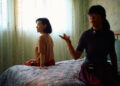
Anthony Chen: I think the initial idea was very much based on a lot of my own feelings during the pandemic. I was having a real existential crisis as a filmmaker when cinemas were closed and I was just sitting at home for two years. There was so much being written about the current younger generation, about the issues around anxiety and feeling hopeless, helpless and let down by the establishment. And there was a collective feeling of this sense of despair, and I was trying to capture that in this film.
But in terms of form, I think this film is quite a departure from my previous two films, and I was actively trying to do that as well. During the first part of 2020, my second film, Wet Season, was released and I was doing a lot of interviews online through Zoom. Everyone was saying, “Oh your films are so precise and pristine,” and there was a real sense of control that was relentless. I would be asked what it would be like to stop controlling yourself so much, to free yourself and let yourself go. I pondered this for two years, and [The Breaking Ice] is almost a reaction to that.
By not having as much control or not being as precise with your directing, how did that change your day-to-day work? Was there more improvisation on set or less reliance on storyboards?
I don’t think so, because I was still very precise. I was still very much a control freak. But in the past, I would spend two or three years on a script sculpting the characters. This time, I allowed the writing to be a free-flowing process. I had a certain outline, a certain shape of how I wanted to make the film, and I sculpted a more basic background of these characters. So in a way, I decided that I wasn’t coming in with a lot of preconceived ideas. This time, it went to a point where the script was constantly moving. If you look at my first two films, they were more naturalistic or social realistic, but there is a dreaminess to [The Breaking Ice]. And in a way, I was putting myself outside of my comfort zone. I decided I’m not going to make this film in Singapore, where I grew up in tropical weather. I decided I’m going to make a winter film, outside of my safety and comfort.
When it came to talking about the younger generation, why did you choose China and not Singapore? I feel like you already started answering that question with your goal of getting out of your comfort zone.
I just remember so many articles during the pandemic discussing the idea of young people in China deciding to quit their jobs, give up and stop doing anything. I was quite obsessed with what was going on because I was born in the ‘80s, and it was so different. I have a very hardworking attitude, and I just keep pushing on and going through the grind of life. I was reading so much about it and just wasn’t understanding why, so this was a way of figuring it out.
With the film taking place on the border of China and North Korea, were there other borders or partitions that you considered, particularly given that separation and borders are such an important theme in the movie?
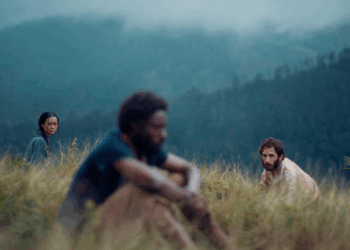
I discovered this border city, and it was almost coincidentally. Like I said, it was a very free flowing process. I was writing [the film], and I knew that it was about three young people who were slightly hurt or damaged, and it would be about mutual help, mutual healing and how they find solace in one another.
At the time, I didn’t decide that I was going to set it in a border city, but I knew at the end of the film I wanted to set it in a wide open and natural environment. I was looking at the map and found this mountain, and when I started to hike up to the top of the mountain, I saw Heaven Lake for the first time. It felt like it cleansed your soul in some way, and there was something very impactful and incredibly moving about seeing that. It was absolutely spectacular and glorious, and because of that, I decided to set the end of the film in this place.
I was then looking at cities that were nearby, and there was a border city [Yanji] where you could look across and see the Korean peninsula. I was captivated by it, and for me, this was the perfect place to talk about young people who are at a crossroads, struggling to redefine themselves and find their identity.
I wanted to end off by asking you about how different your filmography has been over the past few years. Your first two films were primarily in Singapore, and then you made an English-language film and The Breaking Ice, which you filmed in China. Was it very different working outside of your home country?
I would say it’s different because in Singapore, I’m mostly used to having 40 people on set. In China, we had 110 people on set and the actors were telling me that this was the smallest set they’ve been on. They’ve been in a lot of big films and would usually have 200 or 300 people on set and that’s usual for them. But for me, there were so many vehicles and people, and I thought, why do we need so many people to make a film about three people?
I was constantly scratching my head. The working hours are different as well. In China, you just don’t [take] breaks — we follow the U.S. system in Singapore, so you shoot for six days and you have a day off.
Do you already have another film planned as a next project?
I’d been developing a script during the pandemic set in Singapore, and it’s actually a concluding part of my “growing up” trilogy. The first one being Ilo Ilo, the second being Wet Season, and I’ll use the same two leading actors. Koh Jia Ler [the lead actor in those films] is an adult now, and was 11 when I discovered him. The film is called We Are All Strangers, and it’s going to be the final part of the trilogy.